Beyond the Answer: A More Thoughtful Approach to AI-Powered Research
Joan Jacobsen

share


How trusted sources, transparency, and student inquiry shaped ASK Britannica.
AI has quickly become one of the first places people turn when they need an answer. We use it to plan trips, compare options, understand something unfamiliar, solve problems, brainstorm ideas and make sense of complicated information. It’s fast, conversational and increasingly woven into everyday life.
Students aren’t leaving those habits behind when they begin academic research. When they encounter a topic they don’t understand or aren’t sure where to start, asking AI feels like a natural first step. And there is real value in that. A student can ask a question in their own words, get immediate context and begin exploring something that may have felt intimidating moments earlier.
For us, that raised an interesting question as we thought about bringing AI into Britannica Academic:
How could we embrace what makes AI so useful without losing what makes research meaningful?
We didn’t want to add AI simply because students were using it, and we didn’t want to build another tool whose measure of success was how quickly it could produce an answer. Britannica Academic has always served a different purpose in the research journey: helping students build enough knowledge and context to understand a subject, ask better questions, and become better prepared for deeper scholarship.
So the challenge wasn’t simply, “How do we add AI to Britannica Academic?” It was, “What should AI look like when it’s designed specifically to support learning and research?” That question shaped ASK Britannica.
We wanted students to have the ease and immediacy they’ve come to expect from AI, but within an experience where answers begin with content we know and trust. Sources shouldn’t disappear behind a generated response. One question should be able to lead naturally to another. And AI should support students’ thinking without doing the academic work for them.
Those weren’t just product decisions. They reflect a larger conversation happening across higher education. In Britannica Education’s 2026 Higher Education Research & AI Survey, 81% of respondents said it was very or extremely important for educational resources to incorporate AI responsibly. At the same time, 57% were very or extremely concerned about students relying on inaccurate or untrustworthy AI-generated content, while 73% identified information accuracy and trustworthiness as an important institutional AI challenge.
AI is already part of students’ lives and their research habits. The opportunity now is to think more intentionally about what kind of AI experience we want to put in front of them.
Here’s what that thinking looks like in ASK Britannica.
We started with the information behind the answer
ASK Britannica Grounds AI Answers in Trusted Content
If students were going to ask Britannica questions the same way they ask other AI tools, we wanted to be very clear about one thing: where the response came from.
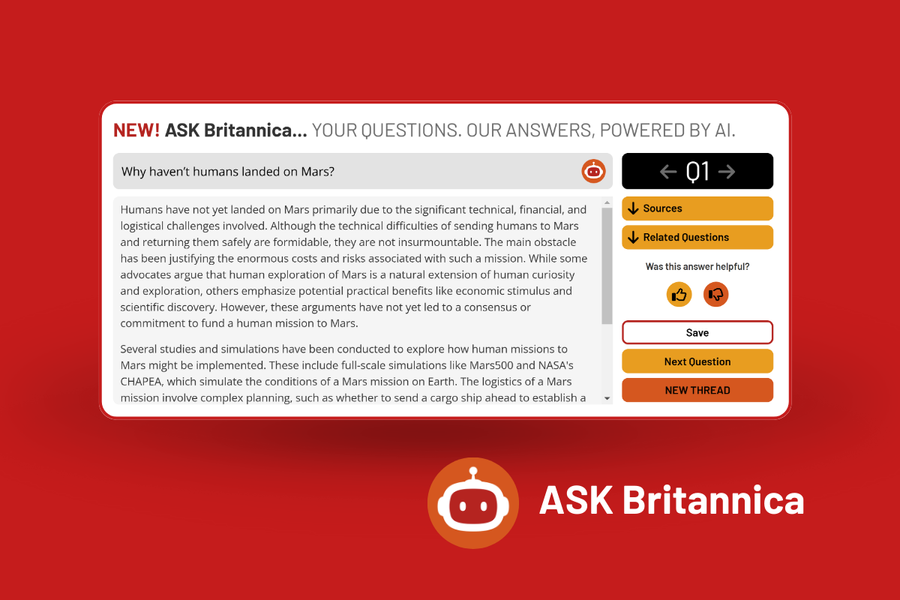
ASK Britannica is a secondary search experience within Britannica Academic. Students can ask a question in their own words and receive relevant insights sourced from Britannica content. It does not search the open web for information of varying quality and provenance—this distinction matters.
AI has an incredible ability to make almost any response sound confident. But for a student encountering a subject for the first time, confidence can easily be mistaken for authority. If you don’t know enough about a topic to recognise what seems questionable, how do you know what deserves your trust?
We wanted students to have the convenience they’ve come to expect from AI while giving them an information environment built around trusted content. But that raised another question for us:
If students see only the answer, is that really enough?
We kept the sources within reach
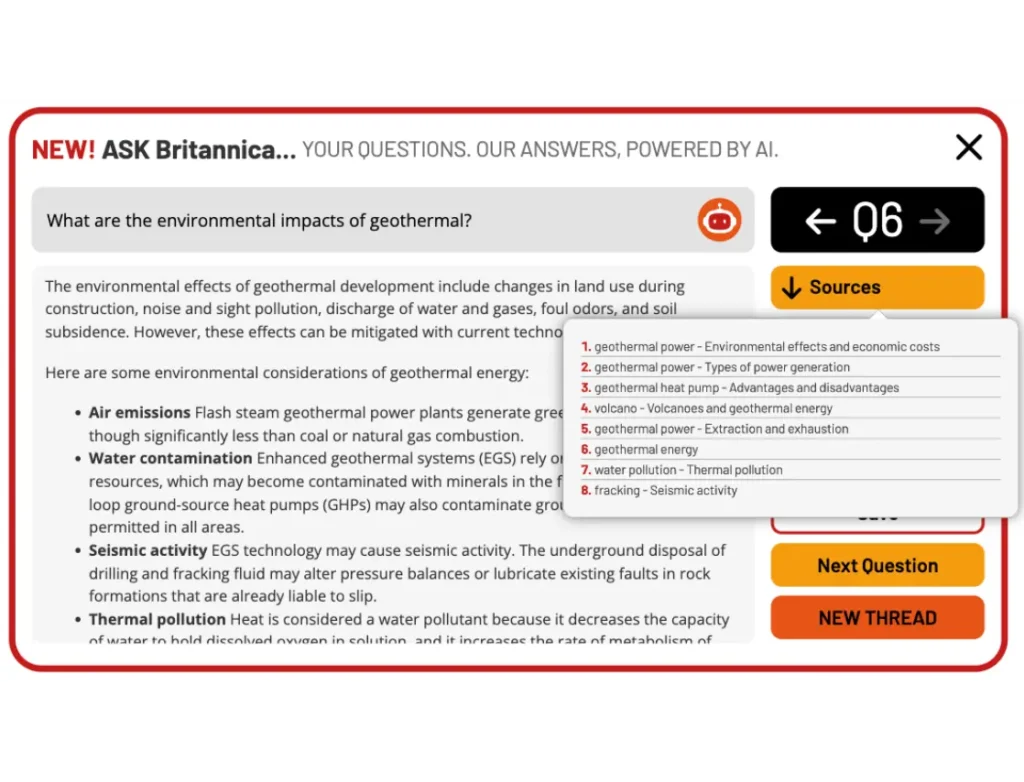
ASK Britannica Connects Students to Its Sources
We didn’t want AI to become a layer between students and the information they were trying to understand. If anything, we wanted it to do the opposite: help students get closer to the source.
ASK Britannica connects students to the response’s underlying Britannica articles. Students can dive directly into those articles, view sources, explore related questions, and continue asking questions within the same thread. That creates a very different research experience than mining the open web, where sources may be biased or fictional.
Instead of, “I asked. AI answered. I’m done,” we want to encourage:
“I asked. I learned something. Where did that come from? What else should I know?”
This experience leaves room for something essential to good research: curiosity.
The first question should rarely be the last
AI-Powered Research Should Encourage Follow-Up Questions
Anyone who has spent time researching knows that the original question often changes along the way. You discover a term you’ve never heard before. One source introduces a perspective you hadn’t considered. Something contradicts what you thought you knew. Suddenly, you’re following a completely different thread.
That’s not research going off track. That’s often when research gets interesting. We wanted ASK Britannica to make room for that kind of exploration. The experience suggests related questions and lets students flip between questions within a thread, while the connected Britannica content gives them somewhere deeper to go.
Imagine a student beginning with a broad question about climate migration. An initial ASK Britannica response might introduce drought, sea-level rise, food insecurity, public policy, economics, or conflict. Any one of those ideas could change the direction of the student’s research. The value isn’t simply that AI answered the first question. It’s that the answer gave the student a reason to ask another one.
Of course, encouraging exploration also means being thoughtful about where AI’s role should end.
We wanted to help with the research, not do the research
Supporting Student Research Without Doing the Work for Them
There’s a meaningful difference between helping a student understand something and producing the work that’s supposed to demonstrate their understanding. That boundary was important to us.
ASK Britannica can help students get oriented to an unfamiliar topic, explore questions, make connections, and find trusted information more easily. But it is not designed to write assignments for students, and it will not respond to inappropriate queries outside its educational scope. This is because the difficult parts of research are often where the learning happens.
Students have to decide which questions are worth pursuing. They encounter conflicting information. They weigh evidence. They determine what matters. They reconsider assumptions. Eventually, they have to decide what they think. AI can make parts of that process easier to navigate, but it shouldn’t take the student’s place in it.
This leads to perhaps the most important role we see for ASK Britannica.
Help students figure out where to go next
How ASK Britannica Supports the Research Process
ASK Britannica isn’t meant to be the entire research journey. Neither is Britannica Academic. Britannica Academic often plays an important role towards the beginning of that journey: helping students build enough foundational knowledge to understand a subject before they move into primary sources, scholarly databases, peer-reviewed literature, and other specialised resources. ASK Britannica gives students another way into that experience.
A student who doesn’t yet know enough about a subject to search effectively can begin with a question. The response helps establish context. They encounter terminology, people, events, and ideas they didn’t know to search for before. They follow the underlying Britannica content, they ask better questions, and then they move deeper.
That’s why ASK Britannica is intentionally a secondary search function within Britannica Academic, rather than an attempt to replace the broader research process. Success isn’t keeping a student inside an AI conversation.
Success is helping students reach the point where they know what to investigate next.
For us, that’s what responsible AI starts to look like
There will continue to be important conversations about AI in higher education. But as the technology grows to be an everyday part of students’ lives, we think there is value in looking beyond what an AI tool can produce and considering what it encourages a student to do.
- Does it encourage students to accept an answer or investigate it?
- Can students see where the information came from?
- Does it invite another question?
- Does it help students understand enough to move into deeper research?
- Does it support student thinking without taking the thinking away from them?
Those are the questions we kept returning to while developing ASK Britannica, and they led us to an experience grounded in Britannica content, connected to visible sources, designed to encourage continued exploration, and intentionally limited so students remain active participants in their own research.
And maybe that’s a useful way for all of us in higher education to think about responsible AI.
The question isn’t simply, “How good is the answer?” It’s also, “What does the student do next?”
The best AI research experience shouldn’t make students research less. It should help them become better researchers.
See ASK Britannica in action
With ASK Britannica, AI doesn’t have to be the end of the research process. It can be the beginning of a better one. Explore how ASK Britannica brings AI-powered exploration into Britannica Academic while keeping trusted content, visible sources, and student inquiry at the center.

About the Author
Joan Jacobsen
Chief Product Officer
Joan brings more than 25 years of experience developing award-winning products for the classroom. She began her career as a classroom teacher before focusing on educational technology and product development. She has been instrumental in developing many high-quality, engaging solutions that support teachers and drive student success including CODE and EdTech Breakthrough Award winners.

Recent Blog Posts

AI Can Find an Answer, BUT Can Students Verify It?
6 Easy Ways to Gamify Britannica School
From Ancient Egypt to Taylor Swift: What Students Explored in 2025

Time-Saving Tips to Get You Through Exam Time

Why Scientific Literacy is the Missing Key to Student Confidence, Comprehension & Communication
A Future with Dinosaurs? Hands-on Challenges for K-8

Making Waves: Ocean Conservation Resources for Schools

“Don’t Start with Inquiry-Based Learning”: Britannica Science Flips the Script with Explicit Instruction
4 Practical Tips for Implementing 21st Century Skills in ELT