






The rise of AI in schools means that from asking ChatGPT for help on essays to turning to AI-driven search tools, today’s learners are navigating a world where answers come fast but not always fairly, safely, or accurately.
For educators, that creates a real challenge: how do you harness the power of AI in schools without undermining research skills, academic integrity, or student safety?
That’s where ASK Britannica comes in. It’s the classroom-ready AI feature built directly into Britannica School: High School.
What Makes ASK Britannica Different?
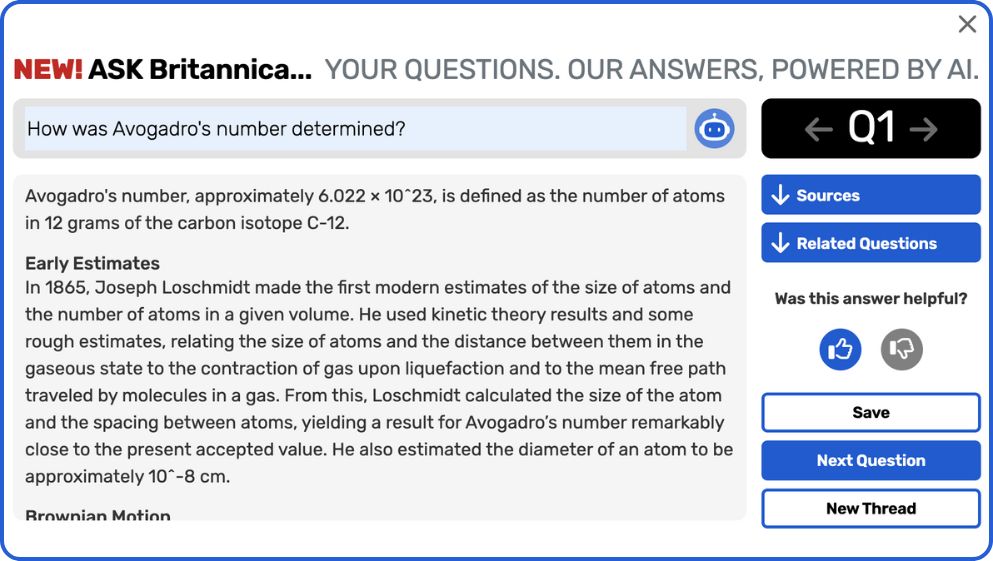
Unlike other AI tools trained on the open internet, ASK Britannica is AI with guardrails that make it curated, safe, and built for learning. Students can type natural-language questions and receive clear, concise answers that link directly to Britannica’s expert-reviewed content.
✅ No Unverified Sources
Answers come from Britannica’s trusted database.
🔒 Safety First
No personal data is collected, and there are no off-topic or inappropriate responses.
🤝 Research, Not Shortcuts
Every answer includes linked articles, related questions, and prompts for deeper exploration.
In short: ASK Britannica delivers the curiosity-sparking power of AI without the risks.
Curiosity Without the Chaos
Students want answers quickly, but they also need accuracy. With ASK Britannica, learners can explore complex questions confidently, knowing what they find is reliable, age appropriate, and designed to support real understanding.
Research Skills That Stick
Every response connects back to Britannica articles, giving students a built-in pathway to learn how to verify, cross-check, and synthesize information. Instead of skipping the hard work of research, ASK reinforces it.
Integrity Built In
Essay writing, misinformation, and bias? Not here. ASK Britannica avoids the pitfalls of generative AI by focusing on credible answers only, helping teachers promote responsible use of AI in schools.
How Educators Can Use ASK Britannica
Think of ASK Britannica as a launchpad for inquiry. Teachers are already finding creative ways to integrate it:
• Kick off a lesson:
Start with a big question, “How do ecosystems maintain balance?” and let ASK spark discussion.
• Support research projects:
Students can refine topics and locate credible background info.
• Develop critical thinking:
Have students compare ASK answers with primary sources or related articles.
• Promote media literacy:
Show students what responsible AI looks like and how it differs from tools that cut corners.
Why This Matters
AI isn’t going away. Students will use it, inside and outside the classroom. The question is: will they use it responsibly?
With ASK Britannica, you can guide them toward safe, trustworthy, and curiosity-driven exploration without sacrificing accuracy, academic integrity, or learning goals.
Want to see ASK Britannica in action? Check out this quick walkthrough to see how it works!
Ready to Try ASK Britannica?
ASK Britannica is now available in the High School level of Britannica School. If your school already subscribes, your students can start using it today. If not, we’d love to show you how this feature can elevate inquiry-based learning in your classrooms.

About the Author
Christopher Heintz
Customer Experience Director
Chris began his career in education as a high school social studies teacher in Chicago. Since then, he’s served in various roles in education management helping teachers navigate the complex world of assessments, data, curriculum, and instruction. Throughout it all, he’s been dedicated to one thing—providing teachers with the tools they need to create positive outcomes for the students in their care!

Recent Posts
Practical Jokes or Practical Adaptations: Can You Find These Critters?
Read More: Practical Jokes or Practical Adaptations: Can You Find These Critters?
Earth Day in Action
Read More: Earth Day in Action
How Deep Are Your Roots? An Earth Day Curiosity Quiz
Read More: How Deep Are Your Roots? An Earth Day Curiosity Quiz
Join Our Newsletter
From tips and tricks to engaging activities, find
attention-grabbing content for tomorrow’s lesson.