




share



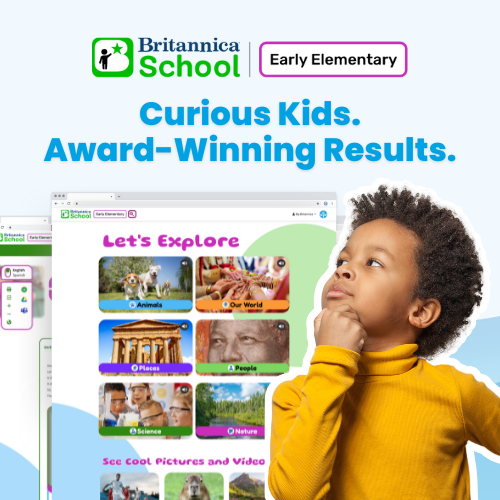
Did you know that when your young readers ask thoughtful questions about nonfiction texts, they’re more likely to retain what they’ve read?
In classrooms across the country, those lightbulb moments—when curiosity meets content—are nothing short of magical. And that magic often begins with access to the right resource at just the right time.
At Britannica Education, the goal is to design every resource with real teachers and students in mind. Drawing on decades of experience in K–12 classrooms—as educators, staff developers, and school leaders—our team is deeply committed to creating tools that support meaningful learning and spark curiosity from the very start.
The Dynamic Duo: Two Game-Changing Resources That Work Together
Educator to educator, I know how precious your time is—and how much of it is spent daily (often after school hours) searching, planning, and adapting material to meet the needs of all of your students. That’s why Britannica Education is proud to offer not one, but two “game changers” that work hand in hand to support and enrich early literacy instruction in your classroom:
Britannica School: Early Elementary
Engaging, age-appropriate nonfiction content specifically designed for preK-2 readers
Teach Britannica
No-prep-needed, open-access teaching resources that extend and complement the digital content
These tools are designed to lighten your load while deepening student learning. And the best part? When used together, they create a seamless early literacy experience—minimal prep, maximum impact.
Let me show you how this duo can transform your instruction and give you back some time for what matters most.


Rich visuals, read-aloud features, and clear text strengthen comprehension pathways.
The content grows with your readers, from shared reading to independent exploration.
Real-world information gives your young readers readers genuine reasons to engage with text.
Content-specific words appear in meaningful contexts, not isolated lists.
Young readers naturally learn to use headings, captions, and bold words.
And the best part? The Britannica School collection grows weekly, with 1000+ articles specifically crafted for early elementary readers, while Teach Britannica continuously develops new resources to support this expanding content!
The Magic Moment: When Comprehension Meets Curiosity
Picture this: A first grader exploring “Why Animals Become Extinct” on Britannica School sees orangutans losing their rainforest homes. She looks up and asks, “Why would people take away their home?” That’s not just reading comprehension—that’s the birth of an empathetic, critical thinker.
During a “Weather Wonders” exploration, a kindergartner points excitedly at a tornado illustration and asks, “How do tornadoes spin?” This launches a whole-class investigation using simple materials to demonstrate air movement—all sparked by engaging, age-appropriate content.
This is what makes Britannica School: Early Elementary different. It doesn’t just build reading skills—it nurtures the natural curiosity that makes reading meaningful.

Beyond “Just Reading”: Building Thinking Pathways
When young readers consistently engage with high-quality nonfiction through this integrated approach, they develop:
Question-Generating Habits: transforming simple “how” questions into more complex “why” inquiries
Connection-Making Skills: linking new information to personal experiences and previous learning
Evidence-Based Reasoning: using specific facts when forming opinions and making arguments
Word Knowledge: incorporating content-specific terms into everyday classroom conversation
Curiosity: using simple lessons to spark classroom inquiry and deeper explorations
Making Monday Morning Easier (Because We’ve ALL Been There!)
As a former teacher, I remember the “Sunday scramble”—searching for just the right resources at just the right level. When used together, our tools take that pressure off, freeing you up to focus on what really matters: small group instruction, one-on-one check-ins, building classroom community, or just catching your breath between transitions!
The Perfect Partnership in Action
Picture your classroom tomorrow: students leaning in, their curiosity sparked, hands in the air, and those small but mighty “aha!” moments unfolding throughout your literacy block. These are the kinds of connections that happen when Britannica School and Teach Britannica come together—supporting the critical preK–2 years when students are both learning to read and reading to learn. Here’s how this partnership can naturally fit into the flow of your day:
💡 Beginning: Gently Spark Curiosity.
Start with wonder. During centers, swap out a task card for a device station where students explore bug articles on Britannica School. Then, seamlessly guide them into “Busy Little Bugs” from Teach Britannica, using simple, print-and-go charts and response sheets. Students stay engaged because they’re connecting digital discovery with hands-on activity—no heavy prep required.
🤝 Developing: Build Understanding Together.
In your community helpers unit, kick things off with a See-Think-Wonder routine using vibrant images from Britannica School. Then, draw from Teach Britannica’s ready-to-use resources like “Leaders and Helpers” or “What is a Community?” to spark thoughtful conversation. You’ll be modeling how to question nonfiction texts in a way that sticks.
🧭 Supporting: Meet Every Learner Where They Are.
Set up a listening station so students who need more time can revisit Britannica School articles with audio support. Use Teach Britannica’s leveled graphic organizers to guide comprehension. These small supports help each child feel successful while allowing them to move at their own pace.
❓Deepening: Bring Themes to Life.
When you’re in the thick of your ocean unit, let second graders dive into underwater exploration with Britannica School’s stunning imagery, then anchor their learning with Teach Britannica’s “Animal Habitats” lesson mini. What starts as curiosity becomes lasting understanding—with everything you need in one place.
🌟📊 Assessing: Check for Understanding with Ease.
Wrap up a lesson with Teach Britannica’s exit tickets—quick, meaningful, and ready to print. They take just minutes to use but offer the kind of insight that helps you plan for tomorrow.
Ready to Transform Your Literacy Instruction?
Every big idea begins with a little spark of curiosity—and with Britannica School and Teach Britannica working together, you have everything you need to ignite those sparks daily. As our database continues growing weekly, so will the possibilities for your young readers!
Ready to transform your literacy instruction with high-quality nonfiction that engages even your youngest readers? We’re ready for you!

Recent Blog Posts

Beyond the Answer: A More Thoughtful Approach to AI-Powered Research
Read More: Beyond the Answer: A More Thoughtful Approach to AI-Powered Research
AI Can Find an Answer, BUT Can Students Verify It?
Read More: AI Can Find an Answer, BUT Can Students Verify It?
Read, Play, Connect: Bringing Early Literacy to Life with Britannica
Read More: Read, Play, Connect: Bringing Early Literacy to Life with Britannica
6 Easy Ways to Gamify Britannica School
Read More: 6 Easy Ways to Gamify Britannica School
What Educators Really Think About AI: Insights from ISTE 2026
Read More: What Educators Really Think About AI: Insights from ISTE 2026
From 1776 to Today: The Big U.S. Timeline Quiz
Read More: From 1776 to Today: The Big U.S. Timeline Quiz
Using Britannica School and the World Cup to Score Big in the Classroom
Read More: Using Britannica School and the World Cup to Score Big in the Classroom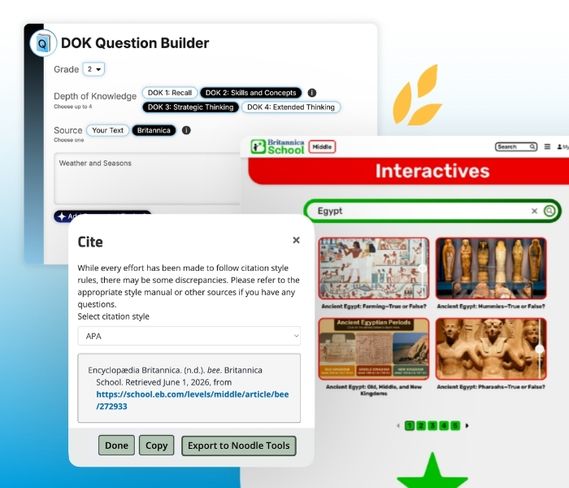
Teach Britannica, for Educators, with Love
Read More: Teach Britannica, for Educators, with Love
Join Our Newsletter
From tips and tricks to engaging activities, find
attention-grabbing content for tomorrow’s lesson.