




Connecting STEM to Real-World Problems
Earth Day, first celebrated on April 22, 1970, aimed to galvanize the U.S. public to recognize and address environmental issues. Today, Earth Day is observed internationally each spring as an environmental movement that highlights the links among the environment, pollution, and human well-being. Earth Day provides an opportunity for students to investigate and analyze environmental problems and ask questions about how they can be solved.
Using authentic STEM challenges empowers students to envision a sustainable future. Proposing, testing, and evaluating solutions to environmental problems drives student engagement and encourages students to consider how they can help shape Earth’s future. Expedition: Learn! supports this approach by providing students with interactive science content and STEM lessons to extend students’ exploration of environmental challenges through hands-on activities. In the featured lesson, Human Impacts on Earth Systems, students learn how human demands on natural resources affect the planet, and they consider sustainable solutions.
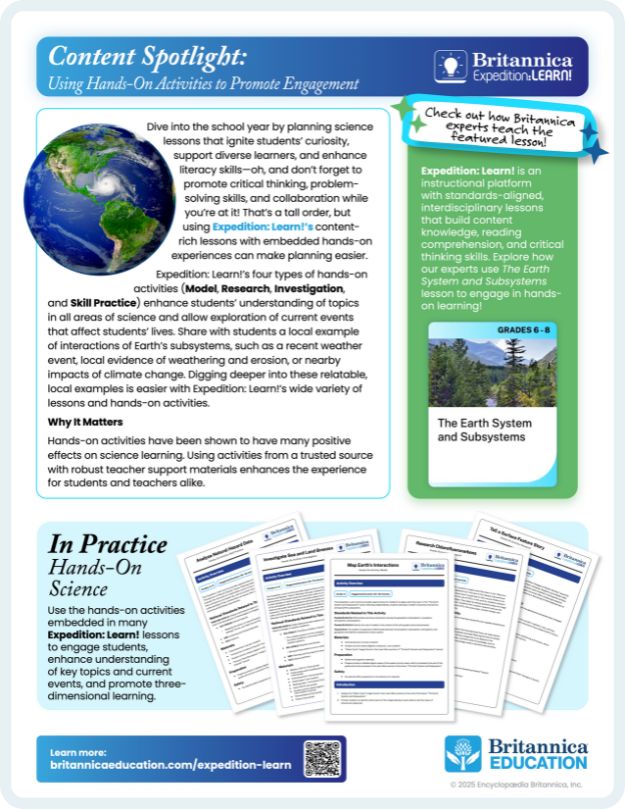
Check out how our experts use the Human Impacts on Earth Systems lesson.
Connecting STEM to the Real World
Exploring issues at the intersection of science and society, such as water management, resource use, and human impacts on the environment, challenges students to think about scientific understandings through a different lens. For example, research conducted by the University of Massachusetts found that “the rate of soil erosion in the midwestern U.S. is 10 to 1,000 times greater than pre-agricultural erosion rates.” Findings such as these provide an opportunity to use current environmental research for classroom exploration.
Try It in Your Class
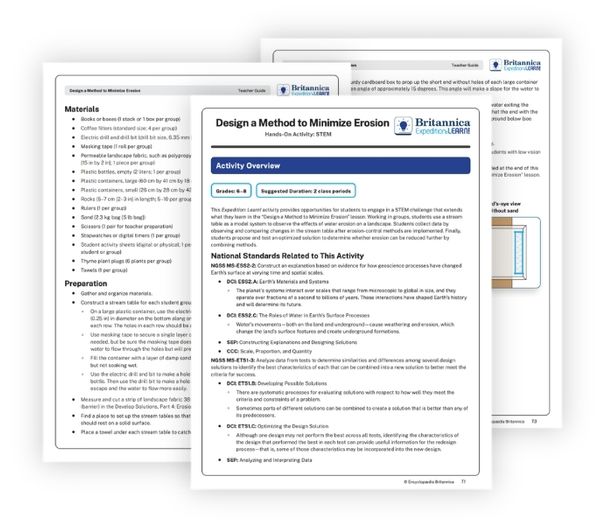
Content Spotlights give you a peek into Expedition: Learn! and its transformative science and literacy content. The STEM labs and hands-on activities available on the platform guide students to explore scientific concepts and the engineering design process. The standards-aligned lessons encourage students to investigate real-world problems with hands-on environmental exploration.
Want access to amazing Earth Day content? Learn more about Expedition: Learn! just in time for Earth Day!
Expedition: Learn! is Britannica’s all-in-one instructional lesson platform. Grounded in decades of research and evidence-based practice, lessons can be used for whole-class instruction, small-group reteaching, or independent practice.
Expedition: Learn! in the Classroom
Get practical, classroom-ready guidance with tips and resources designed to build critical thinking skills.

About the Author
Molly Rhoadhouse
Science Subject Matter Expert
After working in the field of molecular biology, Molly shifted her career focus to educational publishing. As an independent business owner for more than 20 years, she contributed to a vast number of products for clients such as McGraw Hill, Pearson/Savvas, and Twig Science. Molly joined Britannica in 2021, where she has led the Expedition: Learn science team since its inception. In addition to her degree in Life Science, Molly has a graduate certificate in Instructional Design from the University of Wisconsin.

Recent Blog Posts
How Deep Are Your Roots? An Earth Day Curiosity Quiz
Read More: How Deep Are Your Roots? An Earth Day Curiosity Quiz
If We Can’t Trust What We Read, What Does That Mean for AI in Schools?
Read More: If We Can’t Trust What We Read, What Does That Mean for AI in Schools?
Teaching Women of the American Revolution During Testing Season
Read More: Teaching Women of the American Revolution During Testing Season
Women’s History Quiz: Do You Know These Famous Ladies?
Read More: Women’s History Quiz: Do You Know These Famous Ladies?
Trust Comes First: What Teachers Really Want from AI ✨
Read More: Trust Comes First: What Teachers Really Want from AI ✨
Olympic History Quiz: Go for Gold 🥇
Read More: Olympic History Quiz: Go for Gold 🥇
6 Biographical Classroom Strategies to Honor Black History
Read More: 6 Biographical Classroom Strategies to Honor Black History
Meet Britannica Studio: Trusted AI, Built for Teaching
Read More: Meet Britannica Studio: Trusted AI, Built for Teaching
5 Plays for AI-Powered Planning (Free Playbook Download)
Read More: 5 Plays for AI-Powered Planning (Free Playbook Download)
Introducing the New Britannica Escolar: Built for Today’s Learners
Read More: Introducing the New Britannica Escolar: Built for Today’s Learners
Join Our Newsletter
From tips and tricks to engaging activities, find
attention-grabbing content for tomorrow’s lesson.