



Table Of Contents



Using informational text to practice annotating assessment questions
This month marks Women’s History Month, a time to recognize the contributions women have made in the United States and celebrate women’s achievements over the course of American history.
Since the formation of the United States, women have been integral to the country’s development. The fight for independence inspired many men and women alike. Women, constrained by societal norms and legal regulations, found avenues to confront the injustices of British rule, both on and off the battlefield.
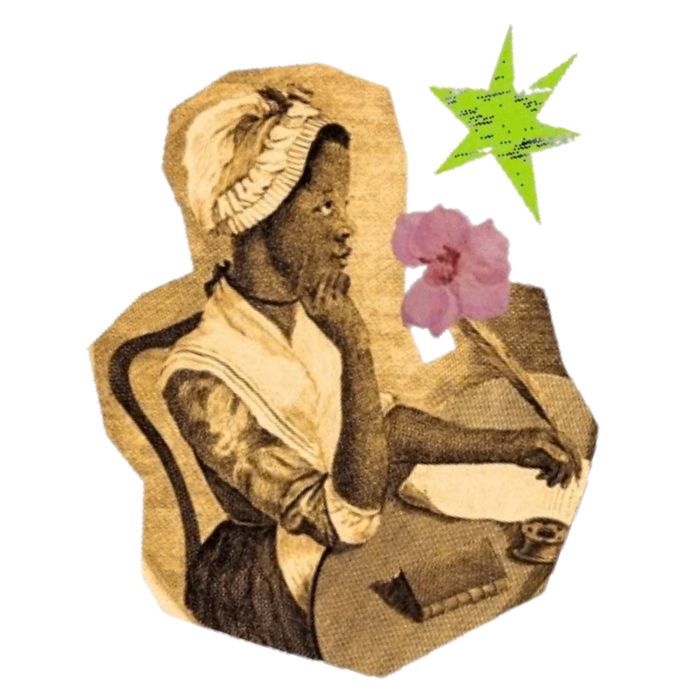
Phyllis Wheatley, kidnapped and enslaved as a child, stands out as the subject of an incredible story of resilience. She used poetry to draw parallels between enslaved people’s fight for freedom and colonists’ fight for liberty. Black people had been enslaved in the colonies for more than 150 years before the Revolution began. Yet they were essential to the cause of independence, in battle and beyond. Wheatley’s words challenged colonial America to live up to its ideals by recognizing the humanity and morality of all individuals.
We can draw inspiration from individuals who took risks to unite people for a cause bigger than themselves. Wheatley’s legacy is a reminder of the enduring power of political speech and the importance of holding nations accountable to their founding principles.
Using Women’s History to Practice Testing Strategies
In addition to Women’s History Month, March also marks the beginning of testing season, and now is the perfect time to review standards and topics likely to be covered in standardized assessments. Whether students need a refresher or practice with assessment items, Britannica Education products, such as Expedition: Learn!, have everything students need to master the content and equip them with the strategies and tools they need to succeed.
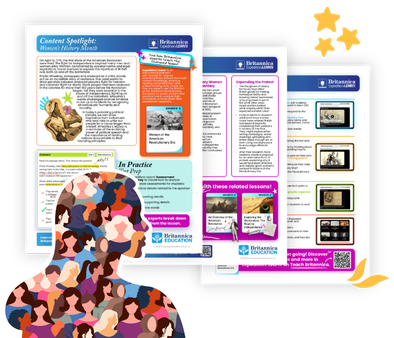
If your school doesn’t have Expedition: Learn! yet, that’s okay. With Content Spotlights, you get a sample of Expedition: Learn! content and can check out how our experts use the Women of the American Revolutionary Era lesson to teach students about the contributions of women in early American history. Additionally, this Content Spotlight provides strategies to practice how to analyze high-complexity standardized-style assessment questions.
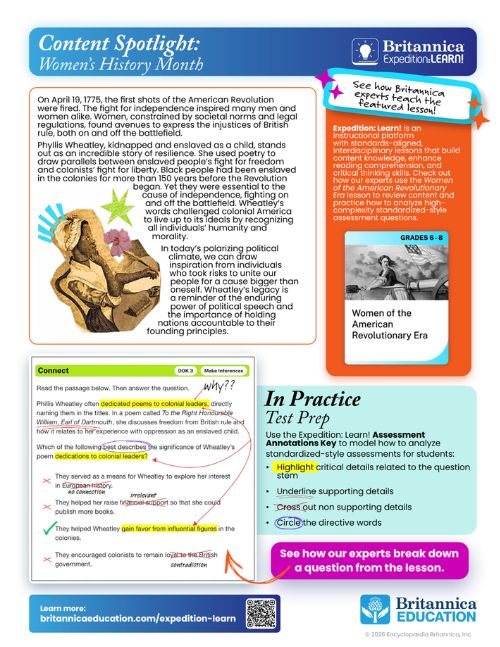
Check out how our experts use the Women of the American Revolutionary Era lesson to highlight the achievements of women and practice how to analyze high-complexity assessment questions.
Annotating High-Complexity Assessment Items
Using informational texts, educators can teach many important comprehension strategies. One strategy that can help students improve reading comprehension is annotating assessment items. Teaching learners to annotate assessment items helps them actively engage with the text and strategically focus on key points. This strategy can help students:
🌟 Remove unnecessary or irrelevant details that distract from the core question
🌟 Identify clues that lead them to the right answer regardless of their background knowledge
🌟 Reduce careless mistakes
🌟 Resist the urge to rush by intentionally breaking down the item
🌟 Identify directive words in the question stem to avoid misinterpretation
🌟 Organize complex information into manageable parts to support visual thinking
Our handy Assessment Annotations Key is designed to be printed, cut, and shared with every student to support them during test prep.
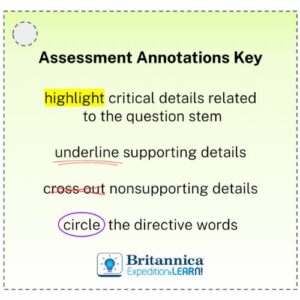

See how our experts use the key to break down a question from the featured lesson!
Expedition: Learn! Helps Teachers Test Prep with Ease
Expedition: Learn! is Britannica’s all-in-one instructional lesson platform. Grounded in decades of research and evidence-based practice, lessons can be used for whole-class instruction, small-group reteaching, or independent practice.
Our Content Spotlights provide a sample of Expedition: Learn! and its transformative science, social studies, and literacy content. If you enjoy the Content Spotlights and want to see the product in action, book a demo of Expedition: Learn! today!
Expedition: Learn! in the Classroom
Get practical, classroom-ready guidance with tips and resources designed to strengthen instruction and boost student performance.

About the Author
Emily Campchero
Social Studies Lead Subject Matter Expert
Emily began her career working in Title I schools, specializing in gifted, MLL, and bilingual education. She has led teams to create content and curriculum at the Positive Psychology Center at the University of Pennsylvania and Teachers College–Columbia University as well as for public school systems such as the New York City and Florida departments of education and the Texas Education Agency. Emily holds a master's degree in Curriculum and Instruction from Teachers College–Columbia University and a bachelor's of science in International Trade and Marketing, with minors in Economics and Latin American Studies, from the Fashion Institute of Technology.

Recent Posts
Women’s History Quiz: Do You Know These Famous Ladies?
Read More: Women’s History Quiz: Do You Know These Famous Ladies?
Trust Comes First: What Teachers Really Want from AI ✨
Read More: Trust Comes First: What Teachers Really Want from AI ✨
Olympic History Quiz: Go for Gold 🥇
Read More: Olympic History Quiz: Go for Gold 🥇
Join Our Newsletter
From tips and tricks to engaging activities, find
attention-grabbing content for tomorrow’s lesson.