


What Does Trust Mean in the Age of AI?

Mrs. Smriti Rawat
Principal, Scholars Abode School Patna
Artificial Intelligence is no longer a distant possibility; it is already present in our classrooms, staff rooms, and in our students’ hands. The question before us is not whether AI will stay—but how we choose to live with it.
Educators are beginning to use AI in meaningful ways. It supports the creation of differentiated worksheets, reflective prompts for interdisciplinary projects, and competency-based questions. In inclusive classrooms, it helps adjust reading complexity and offer varied practice formats—saving time and widening access.
At the same time, a more complex reality is emerging.
Teachers are noticing that student submissions are often impressively worded, yet strangely impersonal. When students rely on AI to think for them rather than with them, the trust between teacher and learner becomes fragile. The output may appear complete, but the process—questioning, analysing, reflecting—can be missing. And that process is where real learning happens.
There are also broader concerns. AI can generate inaccuracies and reflect bias, and its use raises important questions around data privacy. At a policy level, India’s NEP 2020 continues to emphasise critical thinking, ethical reasoning, experiential learning, and responsible use of technology.
This creates a clear tension.
When AI becomes a shortcut, it risks weakening the very habits education is meant to build—originality, analysis, and reflective effort.
As schools continue to explore AI, certain principles are becoming non-negotiable:
AI can support learning—but it cannot replace judgement, care, or the relationships that shape meaningful classrooms.
Many educators describe this moment as both exciting and humbling. We are learning alongside our students, and discovering new possibilities while navigating new challenges.
What is becoming clear is this: trust does not lie in the tool, but in how it is used.
With the right support, AI can be integrated in ways that remain grounded in pedagogy and verified knowledge. Tools like Britannica Studio help educators create classroom-ready materials while staying in control of content, intent, and learning outcomes.
With honesty, wisdom, and responsibility, AI can enrich education—without diminishing its purpose.
Mrs. Smriti Rawat
Principal, Scholars Abode School Patna

Recent Blog Posts


Academic Integrity and the Responsible Use of Artificial Intelligence in Schools
Read More: Academic Integrity and the Responsible Use of Artificial Intelligence in Schools
Rethinking Assessment in the Age of A.I.
Read More: Rethinking Assessment in the Age of A.I.
From Curiosity to Critical Thinking
Read More: From Curiosity to Critical Thinking
Responsible AI in Cambridge & IB Classrooms
Read More: Responsible AI in Cambridge & IB Classrooms
How IB and Cambridge Educators Can Maintain Pedagogical Depth
Read More: How IB and Cambridge Educators Can Maintain Pedagogical Depth
Summer Reimagined: How the Britannica Summer Spark Series is Transforming Learning
Read More: Summer Reimagined: How the Britannica Summer Spark Series is Transforming Learning
Creating Confident Thinkers Through Appreciation and Encouragement
Read More: Creating Confident Thinkers Through Appreciation and Encouragement
More Than Entertainment: Why World Television Day Matters
Read More: More Than Entertainment: Why World Television Day Matters
Empowering Future Leaders Through Skill-Based Learning
Read More: Empowering Future Leaders Through Skill-Based Learning
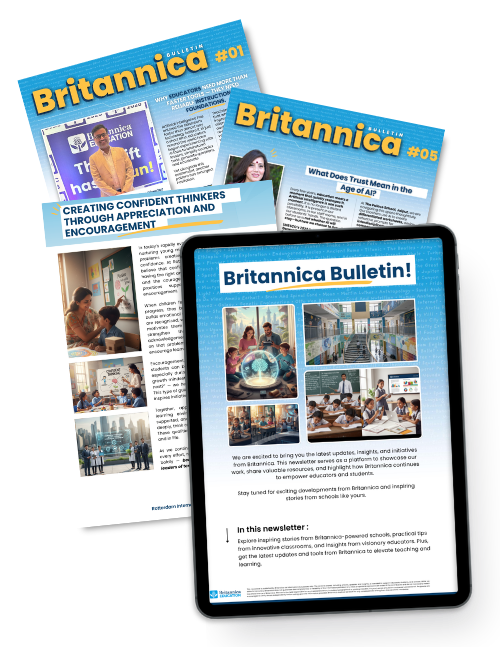
This story was featured in:
The Britannica Bulletin
Your source for monthly updates, resources, and stories empowering educators and students.
Recent Blog Posts
Academic Integrity and the Responsible Use of Artificial Intelligence in Schools
Read More: Academic Integrity and the Responsible Use of Artificial Intelligence in SchoolsRethinking Assessment in the Age of A.I.
Read More: Rethinking Assessment in the Age of A.I.From Curiosity to Critical Thinking
Read More: From Curiosity to Critical ThinkingResponsible AI in Cambridge & IB Classrooms
Read More: Responsible AI in Cambridge & IB ClassroomsHow IB and Cambridge Educators Can Maintain Pedagogical Depth
Read More: How IB and Cambridge Educators Can Maintain Pedagogical DepthSummer Reimagined: How the Britannica Summer Spark Series is Transforming Learning
Read More: Summer Reimagined: How the Britannica Summer Spark Series is Transforming LearningCreating Confident Thinkers Through Appreciation and Encouragement
Read More: Creating Confident Thinkers Through Appreciation and EncouragementMore Than Entertainment: Why World Television Day Matters
Read More: More Than Entertainment: Why World Television Day Matters