


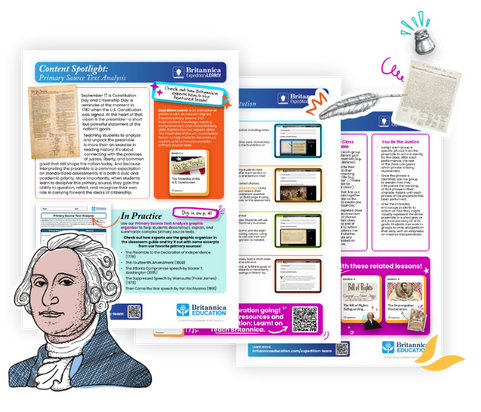
Celebrate Citizenship and Constitution Day with Expedition: Learn!

Emily Campchero



Help students deconstruct, explain, and summarize primary sources
Did you know that September 17 is Constitution Day and Citizenship Day? A day established as a reminder of the moment in 1787 when the U.S. Constitution was signed. At the heart of that vision is the preamble—a short but powerful statement of the nation’s goals.
Teaching students to analyze and unpack the preamble is more than an exercise in reading history; it’s about connecting with the promises of justice, liberty, and common good that still shape the nation today. And because interpreting the preamble is a common expectation on standardized assessments, it is both a civic and academic priority. More importantly, when students learn to decipher this primary source, they gain the ability to question, reflect, and recognize their own role in carrying forward the ideals of citizenship.
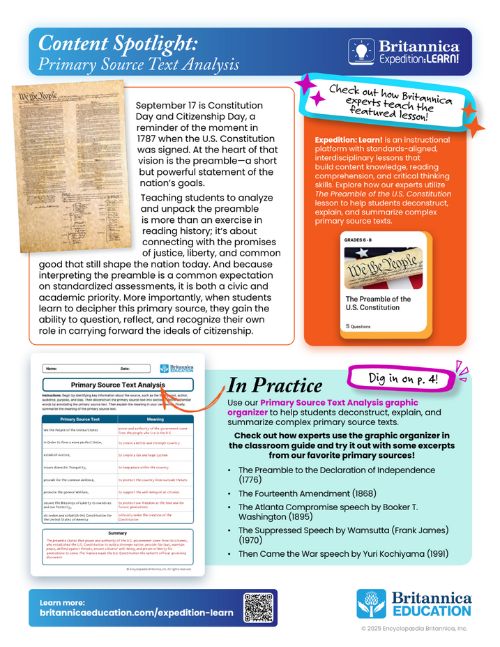
That’s where Britannica Expedition: Learn! comes in; explore how our experts use our Primary Source Text Analysis graphic organizer to analyze primary sources like the U.S. Constitution!
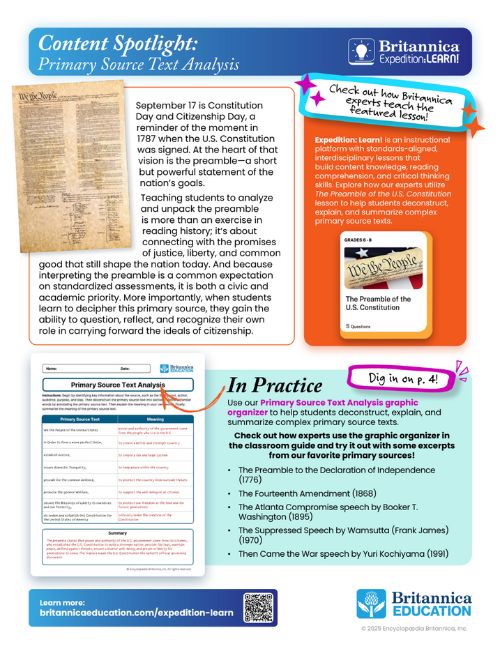
Check out how our experts use The Preamble of the U.S. Constitution lesson to help students deconstruct, explain, and summarize complex primary source texts.
Primary Source Text Analysis with Expedition: Learn!
The graphic organizer, included in the download, can be used with the featured Expedition: Learn! lesson—or you can try it out with an excerpt from your favorite Constitution Day and Citizenship Day primary sources!
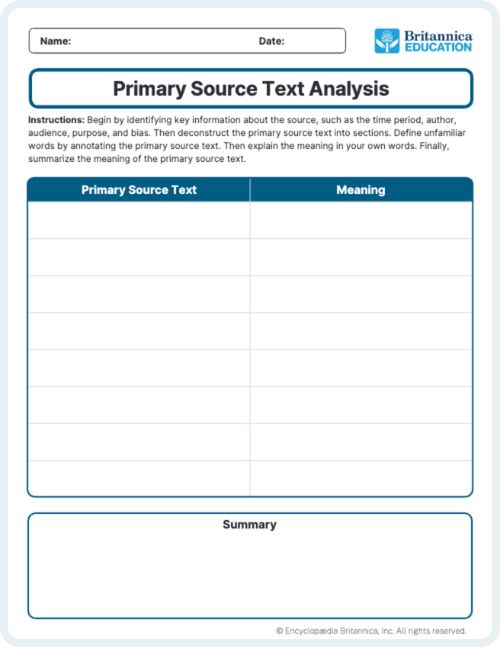
Here are some suggestions you can try in your classroom:
The Preamble to the Declaration of Independence (1776)
The Fourteenth Amendment (1868)
The Atlanta Compromise speech by Booker T. Washington (1895)
The Suppressed Speech by Wamsutta (Frank James) (1970)
Then Came the War speech by Yuri Kochiyama (1991)
Expedition: Learn! is grounded in decades of research and evidence-based practice. Lessons can be used for whole-class instruction, small-group reteaching, or independent practice. Expedition: Learn! helps students develop meaningful skills that they can use in and out of the classroom, all year long! Book a demo of Expedition: Learn!
Expedition: Learn! in the Classroom
Check out how our experts use The Preamble of the U.S. Constitution lesson to help students deconstruct, explain, and summarize complex primary source texts.

About the Author
Emily Campchero
Social Studies Lead Subject Matter Expert
Emily began her career working in Title I schools, specializing in gifted, MLL, and bilingual education. She has led teams to create content and curriculum at the Positive Psychology Center at the University of Pennsylvania and Teachers College–Columbia University as well as for public school systems such as the New York City and Florida departments of education and the Texas Education Agency. Emily holds a master’s degree in Curriculum and Instruction from Teachers College–Columbia University and a bachelor’s of science in International Trade and Marketing, with minors in Economics and Latin American Studies, from the Fashion Institute of Technology.

Recent Posts

Practical Jokes or Practical Adaptations: Can You Find These Critters?
Read More: Practical Jokes or Practical Adaptations: Can You Find These Critters?
Earth Day in Action
Read More: Earth Day in Action
How Deep Are Your Roots? An Earth Day Curiosity Quiz
Read More: How Deep Are Your Roots? An Earth Day Curiosity Quiz
Join Our Newsletter
From tips and tricks to engaging activities, find
attention-grabbing content for tomorrow’s lesson.