






Key Takeaways
Caleb Long’s experience illustrates how Britannica Studio helps districts preserve rigor and equity while easing teacher workload and returning time to instruction without compromising quality.
- ⏰ Reduced Planning Time: 4–5 hours saved per unit
- ✅ Verified, Source-Linked Content: Less rework and verification
- 📊 Built-In Differentiation: Multiple reading levels without sacrificing rigor
- ✨ Workflow Alignment: Materials generated in formats teachers can use immediately
- 🧑🏫 Teacher-Led AI: Educators remain in control of review and implementation
Saving Time Without Sacrificing Rigor
For Caleb Long, who teaches fifth- and sixth-grade social studies in the rural West Side School District of Greers Ferry, Arkansas, time is not an abstract concept. With 63 students and a curriculum spanning world geography, world history, and literacy standards integration, every planning hour matters.
Like many educators, Mr. Long’s biggest planning challenge wasn’t creativity. It was differentiation. Finding rigorous, age-appropriate materials that worked across reading levels required hours of searching, adapting, and rewriting.
He occasionally experimented with general AI tools to save time, but that came with its own cost. Outputs lacked depth. Their accuracy required time-consuming verification. Content often needed rewriting or leveling. What promised efficiency created additional work.
“I want the highest quality materials for my students,” he explains. “With most AI-generated material, I have to read carefully, fact-check, and make changes.” That was the cycle until he participated in the global beta test of Britannica Studio.
A Different Kind of AI
Having used Britannica content in his classroom for years, Mr. Long was immediately curious about an AI tool built on a source he already trusted. For eight weeks, he used Studio freely in real instructional contexts. What stood out first was not speed—it was usability.
“In most AI tools, you can generate content and maybe some related questions,” he said. “In Studio, it was effortless to generate a text along with an aligned quiz that was already formatted and ready to use.” Studio didn’t just generate content. It generated classroom-ready materials grounded in verified sources.
Mr. Long still reviewed outputs, as any responsible teacher would, but found he did not need to edit the text itself. “With Studio’s generated materials, I checked through the content but did not have to make any revisions.”
Differentiation Without Cutting Corners
For Mr. Long, the most transformative feature was built-in text leveling. In many classrooms, differentiation means shortening texts or limiting complex concepts for struggling readers. He describes that approach as “a disservice,” because students lose the opportunity to engage fully with ideas.
Using Studio, he generated the same passage at three reading levels—below grade level, at grade level, and above grade level—while preserving core concepts and rigor. “The passage included the same content and looked the same from the outside,” he explains. “But I was able to meet the needs of all learners without a lot of effort.”
In another lesson focused on informational essay writing, leveled access to content allowed students to concentrate on composition rather than decoding complexity. For a district balancing literacy standards, content rigor, and equity, that flexibility was significant.
The Outcome: Time Returned to Teaching
Mr. Long estimates that Studio saved him four to five hours of planning per unit, time previously spent searching, rewriting, or leveling materials. Beyond saving time, Studio filled a gap he didn’t realize existed.
“It gave me specific content tailored to my lessons without the hassle of hunting down articles that didn’t quite fit my goals,” he says. “It filled a gap in my planning.”
When asked how he would describe Studio’s value to colleagues, his answer was simple:
“Studio generates the materials I need, tailored to my exact learning targets, with content that reflects the accuracy and rigor my students deserve. That combination is invaluable.”
Britannica Studio in Action: The Teacher Experience
Q&A with Caleb Long
Q: What stood out when you first started using Studio?
CL: I was struck by the teacher-specific tools. Most AI tools can generate content, but Studio generated a passage and an aligned quiz that were already formatted and ready to use. It felt built for classrooms, not just content creation.
Q: How important is accuracy and reliable sourcing in AI-generated materials?
CL: It’s everything. AI isn’t useful in the classroom if the content is weak or erroneous. The accuracy and quality of the source material are the most important factors when using AI-generated material.
Q: How much revision did Studio’s materials require?
CL: I always review materials carefully, regardless of the source. With Studio, I checked through the content but did not have to revise it. That’s rare with AI tools.
Q: What challenges do you typically face with differentiation?
CL: There’s a lot of pressure to meet every learner’s needs. Without leveled text, teachers often shorten or simplify content, which can limit student exposure to ideas. This does such a disservice to the student because they need the experience of reading a text in its entirety.
Q: How did Studio support differentiation in your classroom?
CL: I generated the same passage at three levels: below grade level, on grade level, and above grade level. The content stayed consistent, but students could engage at the right level. It allowed me to meet the needs of all learners without a lot of effort on my part.
Q: How did Studio fit into your planning workflow?
CL: It was effortless to include. Instead of searching for materials that only partially matched my objectives, Studio generated content tailored to my learning goals. It filled a gap I didn’t realize I had.
Q: Can you share an example of a lesson or task you created using Studio?
CL: I recently used Studio while teaching the Roman Empire. I generated a list of key achievements I knew students would find interesting and had Studio create short passages explaining each one and its historical significance. I created eight topic options quickly, and students were able to choose which area they wanted to explore. It allowed me to offer choice while keeping the content accurate and aligned to my goals without spending hours searching for or rewriting materials.
Q: How much time did Studio save you?
CL: If I had to estimate the time that was saved with the materials that were generated for a week, it would be the equivalent of 4–5 hours of planning and material preparation for a single unit.
Q: How would you describe Studio’s value to colleagues?
CL: Studio generates the materials I need, tailored to my exact learning targets, with content that reflects the accuracy and the rigor that my students deserve. That combination is invaluable.
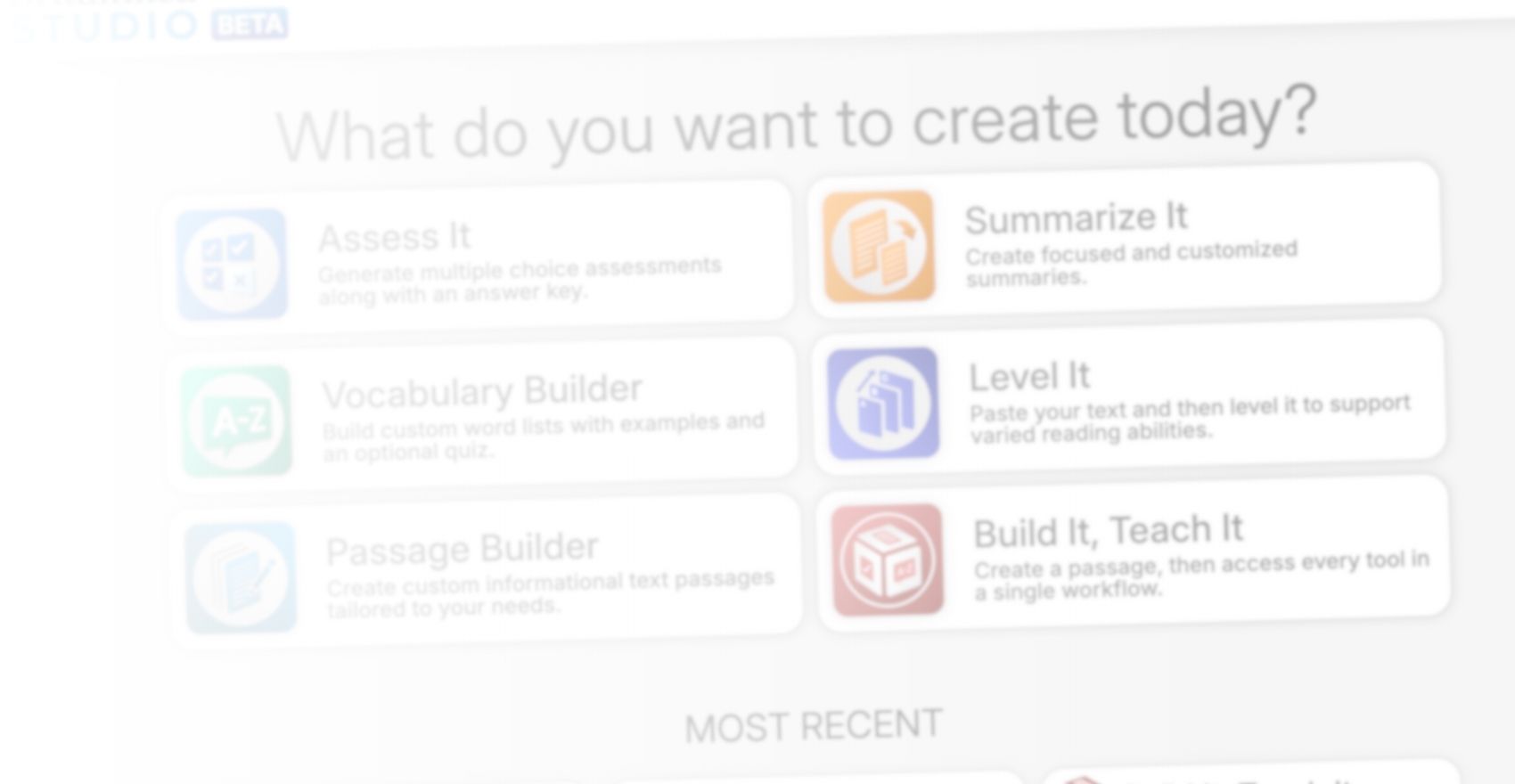
Britannica Studio is your teacher-first AI workspace, helping educators turn Britannica’s verified, standards-aligned content into engaging, differentiated, and student-ready materials in minutes.

Recent Blog Posts

Practical Jokes or Practical Adaptations: Can You Find These Critters?
Read More: Practical Jokes or Practical Adaptations: Can You Find These Critters?
Earth Day in Action
Read More: Earth Day in Action
How Deep Are Your Roots? An Earth Day Curiosity Quiz
Read More: How Deep Are Your Roots? An Earth Day Curiosity Quiz
If We Can’t Trust What We Read, What Does That Mean for AI in Schools?
Read More: If We Can’t Trust What We Read, What Does That Mean for AI in Schools?
Teaching Women of the American Revolution During Testing Season
Read More: Teaching Women of the American Revolution During Testing Season
Women’s History Quiz: Do You Know These Famous Ladies?
Read More: Women’s History Quiz: Do You Know These Famous Ladies?
Trust Comes First: What Teachers Really Want from AI ✨
Read More: Trust Comes First: What Teachers Really Want from AI ✨
Olympic History Quiz: Go for Gold 🥇
Read More: Olympic History Quiz: Go for Gold 🥇
6 Biographical Classroom Strategies to Honor Black History
Read More: 6 Biographical Classroom Strategies to Honor Black History
Meet Britannica Studio: Trusted AI, Built for Teaching
Read More: Meet Britannica Studio: Trusted AI, Built for Teaching
Join Our Newsletter
From tips and tricks to engaging activities, find
attention-grabbing content for tomorrow’s lesson.