

Responsible AI in Cambridge & IB Classrooms
Real Strategies from Teachers at Fravashi International Academy

As AI in Cambridge & IB classrooms becomes increasingly common, leading schools are moving beyond the question of whether to use it and focusing instead on how to integrate AI responsibly while preserving inquiry, academic integrity, and trusted research practices.
At Fravashi International Academy in Nashik, Cambridge and IB educators are using AI to reduce lesson preparation time, personalise inquiry-based learning, and strengthen student research skills without compromising academic integrity.
In this interview, three educators share how they:
Q: How has AI changed the way you plan inquiry-led lessons?
Tasneem Saifee
Physics Tutor
My pedagogical practice has undergone a notable shift from what I would describe as “resource hunting” to
deliberate experience design.
Previously I routinely expended thirty-plus minutes seeking provocations and materials that aligned with Cambridge learners’ needs. Presently, I employ AI to generate conceptual entry points rapidly; with targeted prompts I can produce five differentiated access points within minutes.
Crucially, AI functions as an accelerant for my existing pedagogical framework rather than a substitute for it. By instructing AI to produce variants such as ‘extending, core, and scaffolded’ iterations of an inquiry task, I can operationalise personalisation at scale without incurring unsustainable workload. I retain curatorial responsibility for every output, but the time liberated by AI is now devoted to cultivating student agency, planning formative checks, and pre-empting common misconceptions instead of formatting worksheets or searching for stimuli.
Manjusha Mankar
Artificial Intelligence has significantly transformed the way I conceptualise, design, and implement inquiry-led learning experiences within the Cambridge curriculum. AI serves as a powerful intellectual companion in this process, enabling educators to craft lessons that stimulate learners’ thinking, provoke deeper inquiry, and encourage the exploration of multiple perspectives.
Rather than replacing the creativity of the teacher, it amplifies it, allowing ideas originating from the human mind to be developed with greater precision, coherence, and pedagogical purpose.
Q: How do you help students evaluate AI-generated information?
Manjusha Mankar
Artificial Intelligence is undoubtedly a powerful tool; however, its effectiveness is fundamentally dependent upon the quality, reliability, authenticity, and validity of the data upon which it is trained and the prompts it receives. AI does not independently generate knowledge—it processes, synthesises, and presents information based on existing data and algorithms.
A compelling example of this emerged during the evaluation of a student’s writing. Having provided detailed, individualised feedback on a transactional writing task, I was later approached by a learner who believed his work deserved a significantly higher score based on an assessment generated by ChatGPT. Together, we reassessed the same piece using five different AI platforms and discovered that each tool produced varying results, influenced by its unique algorithms, training data, and evaluation criteria.
This experience reinforced a crucial lesson: AI should serve as a supportive instrument for analysis, organisation, idea generation, and hypothesis testing rather than as the sole authority on accuracy or quality.”
Tasneem Saifee
I adapted the SIFT framework and augmented it by adding a verification step with subject-matter experts. For any substantive claim generated by AI, students are required to triangulate with at least two non-AI sources—such as Britannica entries or subject-specific textbooks.
The work continues in helping learners recognise AI ‘red flags’—absence of citations, an overconfident or definitive tone, and unverifiable specifics. Practically, students now annotate submissions with declarations like ‘AI-assisted draft; verified with Britannica,’ which has proven more effective at cultivating academic integrity than prescriptive policies alone.
Q: Why do you use Britannica alongside AI?
Tasneem Saifee
I regard Britannica as our pedagogical ‘ground truth’ when AI outputs are vague or prone to discrepancies.
The availability of distinct reading levels within Britannica School is transformational for inclusive differentiation: it permits presentation of a single conceptual focus at multiple cognitive and developmental access points, thereby preserving learner dignity while maintaining intellectual rigour.
Beyond textual reliability, Britannica’s multimedia assets—photographs, explanatory videos, and primary-source materials—serve as high-quality inquiry provocations and unit-launch stimuli. In sum, Britannica contributes depth, credibility, and age-appropriate content that synergises with AI-enabled ideation to produce robust, differentiated learning experiences.
Manjusha Mankar
Britannica empowers educators to create highly engaging, inclusive, and differentiated learning experiences that cater to the diverse needs of modern learners. More than a repository of information, Britannica serves as a vast ocean of meticulously researched, tested, and validated knowledge, drawing upon credible primary and secondary sources as well as expert contributions from across disciplines
Through audio support, colour-coded features, animations, visual explanations, and step-by-step elaborations, complex ideas become accessible without compromising academic rigour.
Simultaneously, the platform challenges learners to extend their thinking, question assumptions, and develop metacognitive awareness.
Q: What role should AI play in the future of education?
Legi Mathew
Global Perspectives Tutor
Artificial Intelligence (AI) has emerged as a valuable tool that supports both teachers and students in the learning process. However, while AI provides many benefits, it cannot replace the human qualities that teachers bring to education.
A teacher’s role extends beyond delivering content. Teachers inspire, motivate, guide, and support students emotionally and socially. They help build values, encourage critical thinking, and create meaningful learning experiences that technology alone cannot provide.
The future of education lies not in replacing teachers with technology, but in using technological tools wisely to enrich learning. Teachers remain at the heart of education, guiding students to become informed, responsible, and lifelong learners.

Britannica Studio is your teacher-first AI workspace, helping educators turn Britannica’s verified, standards-aligned content into engaging, differentiated, and student-ready materials in minutes.
FAQ
How can Cambridge teachers use AI responsibly?
Cambridge teachers can use AI to accelerate lesson planning by generating differentiated learning activities, inquiry questions and formative assessments, while maintaining professional oversight. As educators at Fravashi International Academy explain, AI works best as a thought partner—not a replacement for teacher expertise. Tools like Britannica Studio help educators create classroom-ready resources grounded in trusted Britannica content, while ASK Britannica provides a safe AI search experience that supports accurate, curriculum-aligned inquiry.
How do IB schools teach AI literacy?
Leading IB schools teach AI literacy by helping students question AI-generated information rather than accepting it at face value. Students learn to verify facts using trusted sources, identify AI “red flags” such as missing citations or overconfident claims, and compare AI responses with expert-reviewed content. This develops critical thinking, responsible AI use and stronger research habits that align with the IB Learner Profile.
Why do teachers use Britannica alongside AI?
AI can generate ideas quickly, but teachers still need trusted knowledge they can rely on. Britannica complements AI with expert-reviewed, curriculum-aligned content that supports research, inquiry and academic integrity. Educators can use ASK Britannica to search trusted knowledge using AI, while Britannica Studio transforms that verified content into differentiated lessons, assessments, reading passages and classroom activities in minutes.
Why shouldn’t students rely only on open AI tools for research?
Open AI tools can produce information that is incomplete, inaccurate or presented without reliable sources. That’s why educators encourage students to verify AI-generated responses using trusted references such as Britannica. Combining AI with expert-reviewed content helps students develop stronger research skills, recognise misinformation and build the critical thinking needed for responsible use of AI in Cambridge and IB classrooms.

Recent Blog Posts
Hello Britannica Success Stories: Two Schools, Two Unique Learning Journeys
Read More: Hello Britannica Success Stories: Two Schools, Two Unique Learning Journeys
Beyond the Answer: A More Thoughtful Approach to AI-Powered Research
Read More: Beyond the Answer: A More Thoughtful Approach to AI-Powered Research
AI Can Find an Answer, BUT Can Students Verify It?
Read More: AI Can Find an Answer, BUT Can Students Verify It?

Academic Integrity and the Responsible Use of Artificial Intelligence in Schools
Read More: Academic Integrity and the Responsible Use of Artificial Intelligence in Schools
Rethinking Assessment in the Age of A.I.
Read More: Rethinking Assessment in the Age of A.I.
From Curiosity to Critical Thinking
Read More: From Curiosity to Critical Thinking
How IB and Cambridge Educators Can Maintain Pedagogical Depth
Read More: How IB and Cambridge Educators Can Maintain Pedagogical Depth
Summer Reimagined: How the Britannica Summer Spark Series is Transforming Learning
Read More: Summer Reimagined: How the Britannica Summer Spark Series is Transforming Learning
What Does Trust Mean in the Age of AI?
Read More: What Does Trust Mean in the Age of AI?
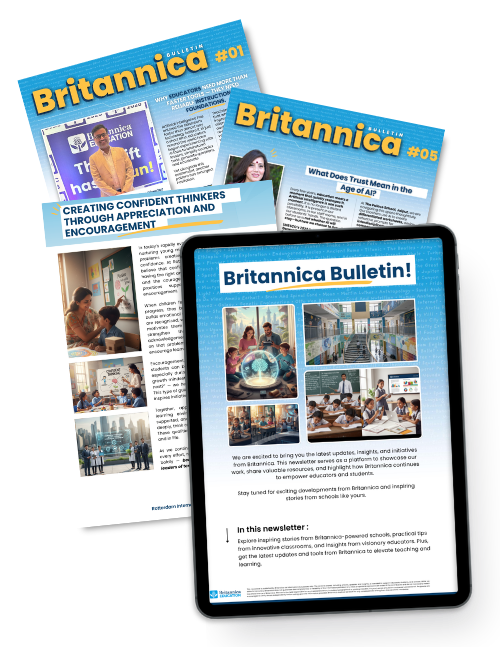
This story was featured in:
The Britannica Bulletin
Your source for monthly updates, resources, and stories empowering educators and students.