





Help Students Identify and Analyze Patterns with Crosscutting Concepts
What does fall make you think of? Back-to-school time? Cooler temperatures? Pumpkin spice? The progression from summer to fall is a familiar pattern, whether you welcome the change or wish summer could hold on just a little bit longer.
Seasonal changes also provide an accessible and observable entry point to the concept of patterns. In middle school science, students are expected to recognize and analyze patterns in seasonal changes, molecular structure, waves, embryological development, and plate motion—just to name a few. They’re expected to utilize patterns to make predictions and recognize cause-and-effect relationships.
That might sound daunting, but pairing Britannica Expedition: Learn! lessons with Teach Britannica resources provides a ready-to-use solution for promoting understanding of crosscutting concepts, such as patterns.
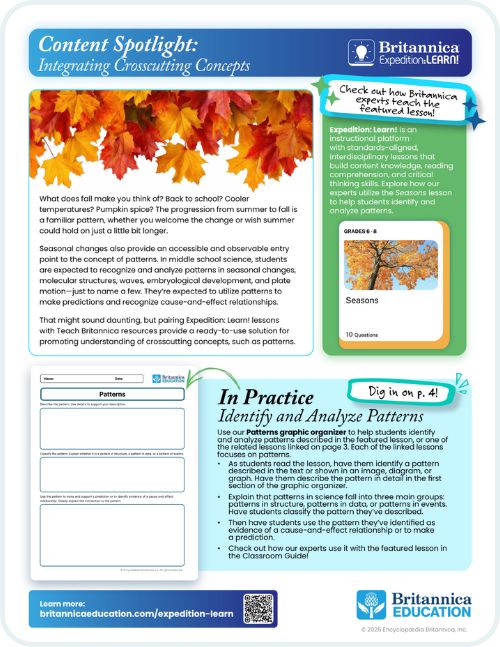
Check out how our experts use the Seasons lesson to help students identify and analyze crosscutting concepts like patternspatterns.
Identify and Analyze Patterns
Focusing instructional time on crosscutting concepts like patterns pays dividends as students apply this information throughout the school year and across disciplines.
Use our Patterns graphic organizer (included in the download) to help students identify and analyze patterns described in the featured lesson, Seasons, or in one of the related Expedition: Learn! lessons. Each of the featured lessons features identifiable patterns.
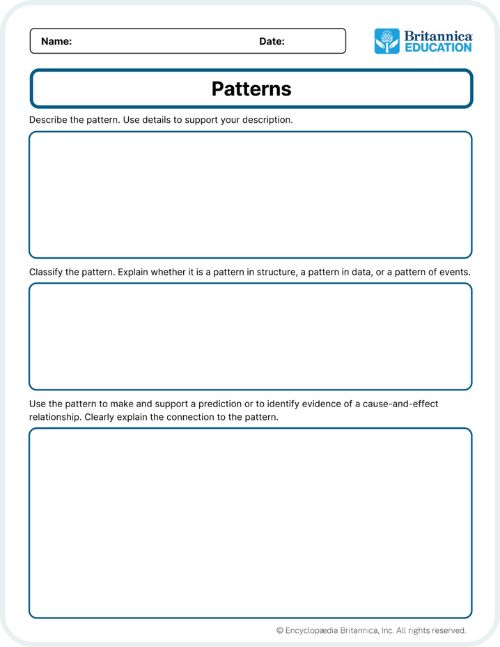
Check out one way you can use the graphic organizer in your classroom:
1. Have students read the lesson and identify a pattern described in the text or shown in an image, diagram, or graph.
2. Next, have them describe the pattern in detail in the first section of the graphic organizer.
3. Explain to students that patterns in science fall into three main groups: patterns in structure, patterns in data, or patterns in events. Have students classify the pattern they’ve described based on the three main groups.
4. Finally, have students use the pattern they’ve identified as evidence of a cause-and-effect relationship or make a prediction.
Britannica Expedition: Learn! is grounded in decades of research and evidence-based practice. Lessons can be used for whole-class instruction, small-group reteaching, or independent practice. Expedition: Learn! is the perfect solution to help students work toward standards mastery. Each lesson provides standards-based content and assessment items to support your science instruction. Book a demo of Expedition: Learn!
Expedition: Learn! in the Classroom
Check out how to use the Seasons lesson, which features engaging activities, thoughtful discussion questions, graphic organizers, and more!

Recent Blog Posts

Beyond the Answer: A More Thoughtful Approach to AI-Powered Research
Read More: Beyond the Answer: A More Thoughtful Approach to AI-Powered Research
AI Can Find an Answer, BUT Can Students Verify It?
Read More: AI Can Find an Answer, BUT Can Students Verify It?
Read, Play, Connect: Bringing Early Literacy to Life with Britannica
Read More: Read, Play, Connect: Bringing Early Literacy to Life with Britannica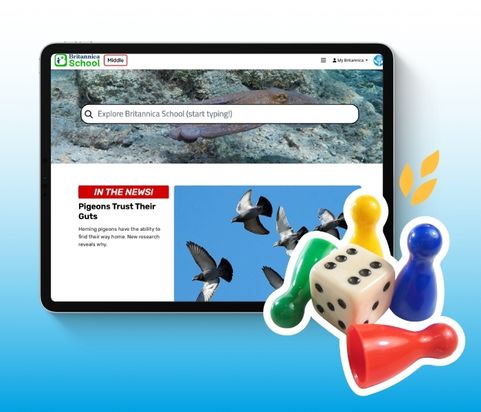
6 Easy Ways to Gamify Britannica School
Read More: 6 Easy Ways to Gamify Britannica School
What Educators Really Think About AI: Insights from ISTE 2026
Read More: What Educators Really Think About AI: Insights from ISTE 2026
From 1776 to Today: The Big U.S. Timeline Quiz
Read More: From 1776 to Today: The Big U.S. Timeline Quiz
Using Britannica School and the World Cup to Score Big in the Classroom
Read More: Using Britannica School and the World Cup to Score Big in the Classroom

Teach Britannica, for Educators, with Love
Read More: Teach Britannica, for Educators, with Love
Join Our Newsletter
From tips and tricks to engaging activities, find
attention-grabbing content for tomorrow’s lesson.