



share


AI can give students an answer in seconds. The opportunity for educators is to teach students what to do next.
Search is changing. AI-generated summaries and conversational search experiences are increasingly becoming part of how students encounter information online. Google recently announced changes that further integrate AI into the Search experience available to schools, highlighting just how quickly traditional search and AI-assisted answers are converging.
For educators, this raises a bigger question than whether students should or shouldn’t use AI: Do students know what to do with search results once they appear?
Finding information has never been faster. But research requires more than finding an answer. Students need to know where information came from, whether it can be trusted, what might be missing, and when to keep looking. That’s where AI literacy comes in: asking effective questions, tracing claims to their sources, evaluating evidence, and looking beyond an AI-generated answer.
In other words, AI doesn’t make research and information literacy less important. It makes them essential.
What Is ASK Britannica?
At Britannica Education, we’ve been thinking carefully about what AI-assisted search should look like when it’s designed specifically for learning. ASK Britannica is Britannica Education’s AI-assisted search experience for student research and inquiry. It allows students to ask questions in natural language, receive age-appropriate, brief answers grounded in vetted Britannica content, and trace those answers back to the underlying Britannica resources. It is available within the High School level of Britannica School, Britannica Library’s Reference Center, and Britannica Academic. And because schools and institutions should have a say in how AI is used in their learning environments, ASK Britannica can be deactivated upon request.
We see ASK as a starting point: a way for students to build background knowledge, develop vocabulary, clarify unfamiliar concepts, and discover better questions before moving deeper into research. That philosophy also gives educators an opportunity to teach students what should happen after AI provides the first answer.
What AI literacy and research skills do students need?
Students need to learn how to ask focused questions, trace information back to its sources, expand their research beyond an initial response, evaluate evidence, and synthesize information across multiple sources.
AI-assisted search can support that process. But the first answer should be the beginning of inquiry, not the end of it. At Britannica Education, we think about the inquiry process in five steps:
Begin with a focused research question.
Identify the sources behind an AI-generated answer.
Consult additional sources and perspectives.
Assess credibility, evidence, authorship, and context.
Compare evidence and develop an evidence-based conclusion.
Here’s how educators can apply each step of the framework in practice:
1. ASK
Start with a better question.
Good research begins with curiosity, and AI-assisted search can be especially useful during the early stages of inquiry when students are trying to understand an unfamiliar topic, identify important vocabulary, clarify a concept, or turn a broad interest into a researchable question.
A student researching renewable energy, for example, might begin by asking: What are the major advantages and disadvantages of solar energy? The goal at this stage isn’t to produce the final answer but to establish enough understanding to know what to investigate next.
2. TRACE
Where did that answer come from?
Tracing information back to its source is one of the most important research habits students can develop in an AI-powered information environment. Don’t stop at the answer. Trace it.
What source supports the claim? Who created that source? What additional context does it provide? Can the student see the evidence behind what the AI has summarized? This is also where the design of the AI tool matters.
With ASK Britannica, students can ask questions in natural language and receive responses grounded in Britannica’s vetted content. More importantly, students can follow those responses back to their underlying Britannica articles and continue investigating. ASK Britannica doesn’t replace Britannica’s editorial foundation with AI. It uses AI to help learners explore it.
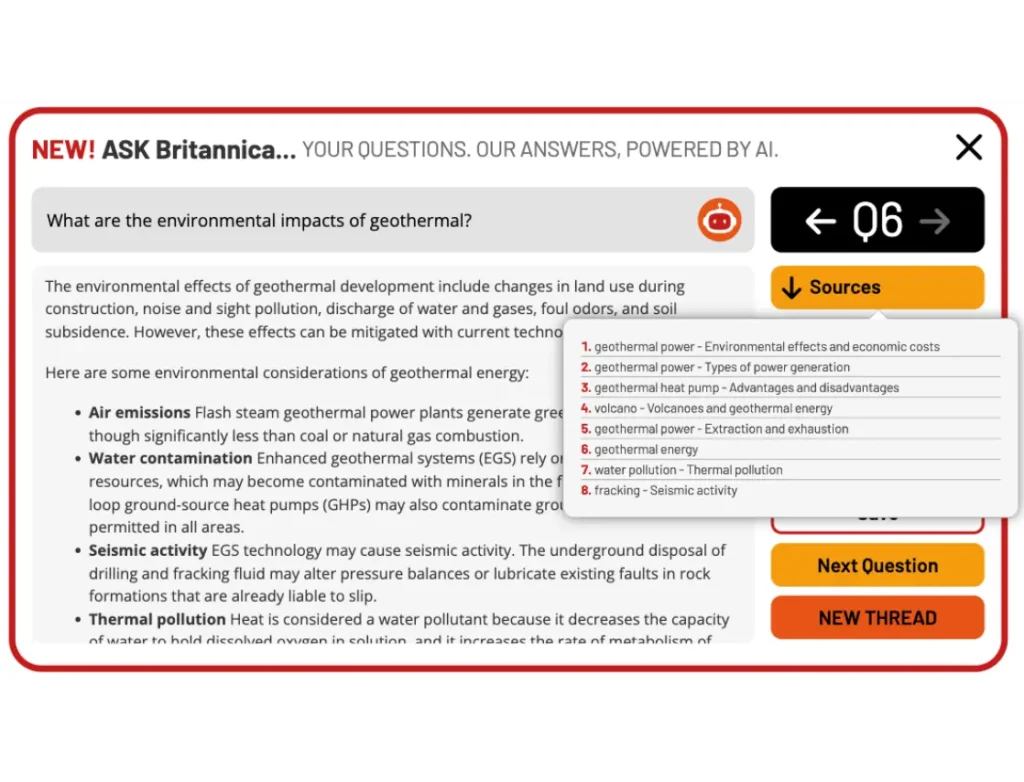
That source transparency gives educators an opportunity to turn a behavior students already understand, such as asking a question, into a lesson about evidence, authorship, and verification.
3. EXPAND
Don’t let the first answer become the last.
Once students have enough background knowledge to understand a topic, it’s time to widen the lens. An AI-generated response might introduce a concept. A full article can provide context. A primary source might reveal a firsthand perspective. An academic database can support deeper investigation. Current journalism may be necessary for understanding a developing event.
Students need to learn that different questions require different information sources for answers. That’s an important distinction in a world where the easiest information to access can quickly feel like the only information students need.
With ASK Britannica, students can move from an initial response into full Britannica articles and connected resources. From there, educators can encourage them to branch into primary sources, academic databases, reputable journalism, and targeted open-web research when the question requires additional evidence or perspectives.
The lesson is to know when and why to move beyond a single research tool.
4. EVALUATE
An answer is not the same as evidence.
AI can summarize information remarkably quickly. It cannot relieve students of the responsibility to think critically about what they encounter. As students expand their research, encourage them to ask:
- Who created this information?
- What evidence supports the claim?
- When was it published or updated?
- What is the purpose of the source?
- Is another perspective missing?
- Can I verify this information somewhere else?
- Is this the right source for the question I’m trying to answer?
These questions aren’t new, but AI makes them newly urgent. Students are no longer evaluating only webpages, articles, videos, and social posts. They’re increasingly sifting through generated responses that can synthesize information before the learner ever encounters the original sources. That makes source awareness a foundational AI literacy skill.
5. SYNTHESIZE
Turn information into understanding.
Research doesn’t end when students collect enough sources. The most important work happens next. Students need to compare evidence; identify relationships and contradictions; consider multiple perspectives; and develop an explanation, conclusion, or argument of their own. That distinction matters enormously in the age of generative AI.
As students investigate, they should be able to explain how their understanding changed, which evidence influenced their thinking, where their sources agreed or disagreed, and why they reached the conclusion they did.
And when they communicate their conclusion, they should cite the underlying sources and not simply treat an AI-generated summary as the authority.
How can teachers and librarians teach AI literacy together?
AI literacy shouldn’t live in one isolated “AI lesson” and neither should information literacy. Both become more meaningful when students practice them repeatedly while investigating real questions in science, history, literature, civics, and other disciplines.
That creates a particularly valuable opportunity for collaboration between classroom teachers and library media specialists. Classroom teachers bring disciplinary expertise, curriculum goals, and meaningful questions tied to what students are learning. Library media specialists bring expertise in search strategy, source evaluation, verification, lateral reading, citation, and information-seeking behavior. Together, they can help students understand not only what they’re learning, but how they know it.
What does AI literacy look like in the classroom?
The ASK → TRACE → EXPAND → EVALUATE → SYNTHESIZE process can work across disciplines.
History
Trace a claim to the evidence
Students ask: What factors contributed to the start of the Cold War?
After reviewing an initial AI response, they identify two claims and trace them to supporting sources. Then, they compare those accounts with a primary source and consider how the evidence adds context or complexity.
Skills practiced: claim tracing, primary-source analysis, corroboration, historical interpretation.
Environmental Science
Build knowledge before deeper research
Before beginning a project on renewable energy, students use AI-assisted search to establish foundational knowledge and identify important scientific vocabulary. They then use those terms to develop a narrower research question and investigate it through appropriate science resources.
Skills practiced: background research, vocabulary development, question refinement, source selection.
English Language Arts
Compare information environments
Students pose the same question to ASK Britannica and a general-purpose AI or search tool. Rather than simply deciding which response is “better,” they examine authorship, sourcing, evidence, purpose, potential bias, and opportunities for verification. Then, they decide which information environment would be most useful for different research tasks and explain why.
Skills practiced: source evaluation, rhetorical analysis, media literacy, metacognition.
Civics
Move from foundational knowledge to current events
Students begin with: How does the Electoral College work, and why is it debated?
They first establish historical and constitutional context, then identify what information they still need to understand the issue today. From there, they move into reputable current journalism and policy sources, documenting how new evidence changes or deepens their understanding.
Skills practiced: contextual research, current-events literacy, perspective analysis, synthesis.
Why do sources matter when students use AI?
Not all AI-assisted search experiences are based on the same information environment. General-purpose tools may draw from broad collections of online information. That can be useful for many purposes, but it also places significant responsibility on students to determine where claims originated and whether those sources are appropriate for academic work.
ASK Britannica takes a different approach. Responses are grounded in Britannica content, giving students a known starting point and a clear pathway back to the underlying resources. That matters because Britannica’s content isn’t simply collected from across the web. Our articles and resources are developed and maintained through an editorial process centered on subject expertise, professional editing, fact-checking, source review, and ongoing updates. AI sits on top of that trusted foundation, not in place of it.
For developing researchers, ASK Britannica creates a useful bridge: the accessibility of conversational search combined with the source transparency and editorial rigor needed for learning responsible research habits.
When should students move beyond an AI-generated answer?
Often, researchers should start digging into a topic outside of AI tools sooner than they think. AI-assisted search can be particularly useful during pre-search and exploration when students are building background knowledge, clarifying concepts, learning vocabulary, or narrowing a topic. But as questions become more specialized, students should learn to change tools.
They may need:
- A full reference article for greater context
- A primary source for firsthand evidence
- An academic journal for specialized scholarship
- Current journalism for recent developments
- Multiple perspectives for a contested issue
- Original data for an evidence-based argument
Knowing when a research tool is no longer sufficient is itself an important research skill. Independent researchers don’t simply know how to search. They know when to search differently.
How can educators teach AI literacy in the classroom?
Educators don’t need to build this experience from scratch. The ASK Britannica: Inquiry, Sources & AI Literacy instructional strategy on Teach Britannica provides a ready-to-use way to practice these habits with upper-secondary and college/university learners.
The 20–30 minute activity asks students to pose a focused question, capture important ideas and vocabulary, trace information into Britannica sources, collect evidence, develop follow-up questions, refine their inquiry, and reflect on how their thinking changed throughout the process.
The accompanying student guide also makes students’ often-invisible research process much easier for educators to see. Instead of assessing only “Did you find the answer?” educators can follow the journey and ask, “How did your question, your sources, your evidence, and your thinking change as you investigated?” That’s a much more interesting measure of learning.
What is the role of AI in student research?
AI shouldn’t be a shortcut around thinking. Used thoughtfully, it can become a scaffold for thinking. The distinction comes down to what happens after the response appears. Do students accept it? Or do they trace it? Question it? Investigate further? Compare evidence? Develop an idea of their own?
We believe responsible AI begins with a student who knows how to investigate a generated output. It’s no longer a question of whether students will encounter AI-assisted search; now, the opportunity for schools is to teach students what to do with it.
Frequently Asked Questions
Can students use AI for research?
Yes, when AI is used as a starting point rather than a substitute for research. Students should trace important claims to their sources, evaluate the supporting evidence, consult additional authoritative resources, and cite the sources that ultimately inform their work.
How can teachers help students verify AI-generated information?
Ask students to identify specific claims in a generated response, locate evidence supporting those claims, compare the information with additional credible sources, and note where sources agree, disagree, or add important context.
What is AI literacy?
AI literacy includes understanding how AI tools produce information, recognizing their capabilities and limitations, evaluating AI-generated content critically, and using AI responsibly and transparently.
Does AI replace information literacy?
No. AI makes information literacy even more important. Students need to evaluate not only individual sources but also generated responses that may summarize or synthesize information before students ever encounter the original evidence.
What is ASK Britannica?
ASK Britannica is an AI-assisted search experience that allows students to ask questions in natural language, receive age-appropriate, brief answers grounded in vetted Britannica content, and trace those answers back to the underlying Britannica resources. It is available within the High School level of Britannica School, Britannica Library’s Reference Center, and Britannica Academic.
Can ASK Britannica be disabled for my students?
Yes, the ASK Britannica search tool is a preference that may be deactivated at the account level upon request.
Ready to Move Beyond the First Answer?
See how ASK Britannica helps students turn natural-language questions into trusted answers, visible sources, and deeper inquiry. ASK Britannica is available in Britannica School: High School, Britannica Library: Reference Center, and Britannica Academic.
New to Britannica?
Contact us to learn more about how ASK Britannica can support inquiry-based research and AI literacy across your school or institution.


Recent Blog Posts

4 Easy Ways School Librarians Can Become Essential Instructional Partners
Read More: 4 Easy Ways School Librarians Can Become Essential Instructional Partners
Beyond the Blank Slide: Create Engaging Lessons with Britannica Studio’s Present It
Read More: Beyond the Blank Slide: Create Engaging Lessons with Britannica Studio’s Present It
Beyond the Answer: A More Thoughtful Approach to AI-Powered Research
Read More: Beyond the Answer: A More Thoughtful Approach to AI-Powered Research
AI Can Find an Answer, BUT Can Students Verify It?
Read More: AI Can Find an Answer, BUT Can Students Verify It?
Read, Play, Connect: Bringing Early Literacy to Life with Britannica
Read More: Read, Play, Connect: Bringing Early Literacy to Life with Britannica
6 Easy Ways to Gamify Britannica School
Read More: 6 Easy Ways to Gamify Britannica School
What Educators Really Think About AI: Insights from ISTE 2026
Read More: What Educators Really Think About AI: Insights from ISTE 2026
From 1776 to Today: The Big U.S. Timeline Quiz
Read More: From 1776 to Today: The Big U.S. Timeline Quiz
Using Britannica School and the World Cup to Score Big in the Classroom
Read More: Using Britannica School and the World Cup to Score Big in the Classroom
Join Our Newsletter
From tips and tricks to engaging activities, find
attention-grabbing content for tomorrow’s lesson.