




Dr. Anirudh Gupta
CEO
D.C.M. Group of Schools
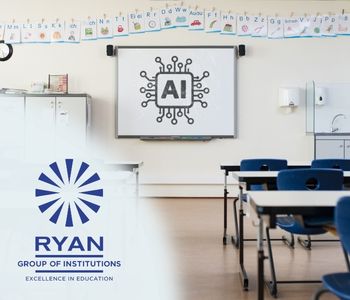
Artificial Intelligence (AI) is fundamentally reconfiguring the educational landscape by transforming the ways in which knowledge is acquired, curated, evaluated, and disseminated. While AI-driven technologies offer unparalleled opportunities for personalised learning, pedagogical differentiation, and institutional efficiency, they simultaneously engender profound ethical and academic dilemmas. Consequently, academic integrity must remain the inviolable cornerstone of educational practice, ensuring that technological innovation augments rather than erodes the enduring values of honesty, accountability, fairness, intellectual rigour, and scholarly authenticity.
School leadership occupies a pivotal position in cultivating an institutional ethos that harmonises technological innovation with ethical responsibility. Educational institutions must formulate robust AI governance frameworks that unequivocally delineate the permissible and impermissible applications of AI across teaching, learning, assessment, research, and administrative processes. Such frameworks should be reinforced through sustained professional development initiatives that enhance educators’ AI literacy, strengthen their ethical decision-making, and equip them with the pedagogical acumen to design authentic, competency-based assessments that substantially mitigate opportunities for academic malpractice. Concurrently, students must receive systematic instruction in digital citizenship, information literacy, ethical reasoning, and responsible technological engagement, thereby empowering them to navigate an increasingly AI-mediated world with discernment, integrity, and confidence.

Furthermore, safeguarding academic integrity cannot be predicated solely upon sophisticated detection mechanisms or surveillance technologies. A more enduring and transformative approach lies in fostering a pervasive culture of trust, transparency, reflective practice, and shared accountability. Assessment paradigms must progressively evolve to privilege oral discourse, collaborative inquiry, interdisciplinary projects, process-oriented documentation, reflective portfolios, and authentic demonstrations of learning that foreground analytical reasoning, creativity, and intellectual originality over mechanical reproduction.
For educators, AI not only offers significant opportunities but also confers profound professional responsibilities. Teachers are entrusted with exemplifying ethical technological stewardship while judiciously harnessing AI to enrich instructional design without relinquishing professional autonomy or pedagogical discernment. AI possesses the capacity to facilitate curriculum planning, assessment design, differentiated instructional resources, formative evaluation, and timely, personalised feedback. Nevertheless, all pedagogical judgements must remain firmly anchored in professional expertise, contextual sensitivity, educational philosophy, and sound ethical principles. Educators must explicitly cultivate students’ capacity to distinguish legitimate academic assistance from intellectual misappropriation, fostering transparency in AI utilisation while nurturing inquiry-driven learning that privileges critical analysis, synthesis, and independent cognition over algorithmic replication.
From the learner’s perspective, AI should function as an intellectual catalyst rather than a surrogate for authentic cognitive engagement. Responsible students employ AI to elucidate complex concepts, stimulate ideation, refine linguistic expression, and obtain formative guidance, while ensuring that the intellectual substance of their work remains prominently their own. The utilisation of AI to fabricate assignments, circumvent authentic assessment, or obscure authorship fundamentally compromises both educational attainment and moral character. Students must therefore cultivate sophisticated digital discernment by critically evaluating AI-generated content, acknowledging technological assistance where appropriate, respecting intellectual property, and recognising that genuine scholarship is defined not by the expedient production of answers but by the disciplined pursuit of knowledge, intellectual curiosity, and independent reasoning.
Ultimately, the responsible application of Artificial Intelligence within education is not an exercise in constraining innovation but in stewarding it with wisdom, prudence, and ethical foresight. When educators serve as exemplars of ethical practice, students uphold the principles of intellectual honesty, and school administrations institutionalise comprehensive governance frameworks, AI becomes a transformative catalyst for meaningful learning rather than an instrument that jeopardises academic credibility. As schools prepare learners for an AI-enabled future, they must ensure that technological fluency is inextricably intertwined with ethical responsibility, critical inquiry, scholarly excellence, and an unwavering commitment to academic integrity.


Recent Blog Posts

Rethinking Assessment in the Age of A.I.
Read More: Rethinking Assessment in the Age of A.I.
From Curiosity to Critical Thinking
Read More: From Curiosity to Critical ThinkingResponsible AI in Cambridge & IB Classrooms
Read More: Responsible AI in Cambridge & IB Classrooms
How IB and Cambridge Educators Can Maintain Pedagogical Depth
Read More: How IB and Cambridge Educators Can Maintain Pedagogical Depth
Summer Reimagined: How the Britannica Summer Spark Series is Transforming Learning
Read More: Summer Reimagined: How the Britannica Summer Spark Series is Transforming Learning
What Does Trust Mean in the Age of AI?
Read More: What Does Trust Mean in the Age of AI?
Creating Confident Thinkers Through Appreciation and Encouragement
Read More: Creating Confident Thinkers Through Appreciation and Encouragement
More Than Entertainment: Why World Television Day Matters
Read More: More Than Entertainment: Why World Television Day Matters
Empowering Future Leaders Through Skill-Based Learning
Read More: Empowering Future Leaders Through Skill-Based Learning
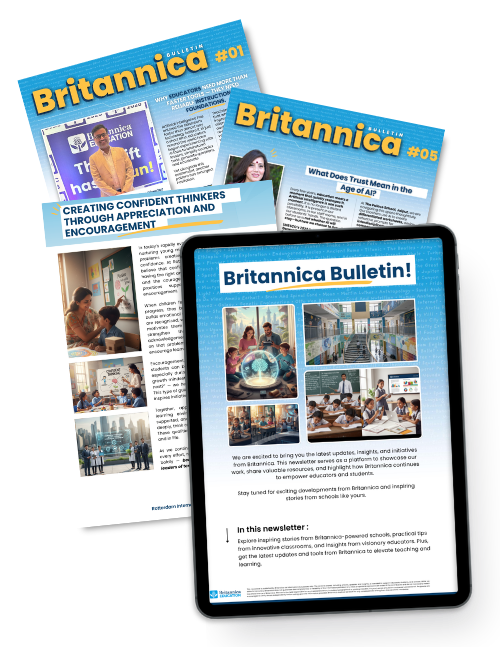
This story was featured in:
The Britannica Bulletin
Your source for monthly updates, resources, and stories empowering educators and students.