



Ms. Sheetal Labru
Principal
Ryan International School, Vasant Kunj
I still remember how hesitant my senior secondary mathematics teacher felt when she said, “You may now take out your calculators.” In the 1980s, it almost felt like cheating! It felt like we were taking away the skill of computing from our students, making them dull. Yet we know that the calculator liberated us from cumbersome computing to explore real mathematics! The calculator didn’t ruin us; it just gave us more time and energy for reasoning, critical thinking, application, and alternate approaches to a problem.
Today, education is again facing the next calculator moment with A.I., and the same anxieties and apprehensions echo in staffrooms and classes. As calculators once challenged numeracy, A.I. challenges literacy and research. Students are already using it, and I would strongly advocate that institutions must not waste their time and resources in policing the use of A.I. As educators, we are well aware that every workplace our student enters will expect them to have A.I. literacy. In fact, we need to prepare our students to work in an A.I.-augmented world.
We need to conduct assessments because tests dictate curriculum, but in an A.I. world, we need to rethink assessment. We need to test our students on skills which A.I. can’t replace, like judgement, creativity, insight, critical evaluation, and ethics. Let us be clear that we can’t ban the tool, but we can transform our tests.
Today, educational institutes can no longer rely on conventional assessment methods that A.I. can bypass easily. What we need is a system of assessment that demonstrates authentic human learning, judgment, critical thinking, and creativity. In a world where A.I. can provide answers, the ability to evaluate, critique, and synthesize information becomes important. Instead of asking our students to summarize a historical event or remember dates of battles, we can ask them to analyze conflicting accounts generated by A.I. We must design assessments that reward novel solutions, artistic expressions, and multidisciplinary thinking. These are skills that require human judgment and cannot be outsourced to A.I.
Assessments should now reward open-ended challenges that require novel thinking instead of formulaic response, such as designing a novel solution to a water crisis in the locality or rewriting a story with twists which requires human creativity. Assessment through dialogues and defence must be prioritised over written essays. When students articulate understanding in real-time conversations, explain their reasoning, respond to unexpected questions, or defend their solutions, they demonstrate intellectual ownership that is difficult to outsource to A.I. Assessments must now be designed around students’ personal contexts. When assignments require students to connect concepts to their unique experiences, communities, or observations, they create barriers to A.I. substitution. We need to stop assessing measuring identical outputs on identical tasks. In an A.I. world, we need to evaluate different perspectives, out-of-the-box thinking, and novel methods to solve a problem.
Thus, rather than prevent A.I. use, which is increasingly becoming a futile endeavour, educators must redesign assessments that evaluate how effectively students collaborate with A.I. as an intellectual tool.


Recent Blog Posts


Academic Integrity and the Responsible Use of Artificial Intelligence in Schools
Read More: Academic Integrity and the Responsible Use of Artificial Intelligence in Schools
From Curiosity to Critical Thinking
Read More: From Curiosity to Critical Thinking
Responsible AI in Cambridge & IB Classrooms
Read More: Responsible AI in Cambridge & IB Classrooms
How IB and Cambridge Educators Can Maintain Pedagogical Depth
Read More: How IB and Cambridge Educators Can Maintain Pedagogical Depth
Summer Reimagined: How the Britannica Summer Spark Series is Transforming Learning
Read More: Summer Reimagined: How the Britannica Summer Spark Series is Transforming Learning
What Does Trust Mean in the Age of AI?
Read More: What Does Trust Mean in the Age of AI?
Creating Confident Thinkers Through Appreciation and Encouragement
Read More: Creating Confident Thinkers Through Appreciation and Encouragement
More Than Entertainment: Why World Television Day Matters
Read More: More Than Entertainment: Why World Television Day Matters
Empowering Future Leaders Through Skill-Based Learning
Read More: Empowering Future Leaders Through Skill-Based Learning
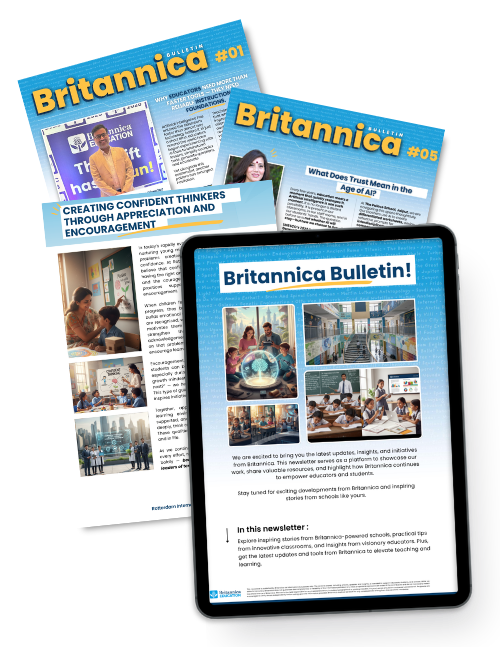
This story was featured in:
The Britannica Bulletin
Your source for monthly updates, resources, and stories empowering educators and students.