



Read, Play, Connect: Bringing Early Literacy to Life with Britannica

share


What happens when a young reader doesn’t just read about recycling, animals, or the world around them, but gets to explore the idea, talk about it, interact with it, and use what they’ve learned?
This is when information starts becoming knowledge!
In early elementary classrooms, children are doing two important things at once: learning to read and learning about the world. Those experiences can strengthen one another. As students build knowledge about a topic, they also build the vocabulary, oral language, and comprehension that help them make sense of increasingly complex texts.
The question is: How do we help young learners do more than simply encounter information?
Read, Play, Connect
Britannica School: Early Elementary and Teach Britannica now unites trusted informational content, interactive exploration, and purposeful teaching strategies, all in the name of making it easier for you to bring learning—and literacy—to life.
Think of the experience in three simple components:
READ
to build knowledge and vocabulary.
Students encounter meaningful informational text, images, and content-specific language.
PLAY
to explore, notice, and make meaning.
Students interact with the topic, revisit important ideas, and see information represented in another way. The goal isn’t simply to play an interactive. It’s to learn and reinforce content through an interactive.
CONNECT
through thinking, talking, reading, and writing.
Teach Britannica strategies and supplemental, differentiated handouts help teachers surround those experiences with purposeful questions, discussion, practice, and reflection so students can use new vocabulary, explain their thinking, and connect new information to what they already know.
Read, Play, Connect. Each piece of the puzzle gives children another opportunity to interact with the same ideas and language. Together, they create a connected literacy experience rather than a collection of activities teachers have to piece together themselves.
See It in Action: Learning About Recycling
Imagine your class is learning about recycling. Teach Britannica’s new Recycling and Composting interactive guide can help you combine an article, an interactive, vocabulary practice, and discussion into a complete activity.
1. Start With What Students Know
Begin with Teach Britannica’s Predict-Connect-Explore implementation strategy. Look around the classroom together and ask:
- What objects in our classroom could be reused?
- Why do people recycle?
Students don’t need to know all the answers. They’re activating background knowledge, practicing oral language, and creating a reason to learn more.
Now the new information has somewhere to land.
2. READ
Build Knowledge and Vocabulary
Read the “Recycling” article in Britannica School as a group. Pause to discuss important words such as recycle, compost, and waste. Give students opportunities to say and use the words:
- I think this could be recycled because…
- Compost is…
- One kind of waste we make at school is…
For young learners, that oral rehearsal matters. Children can begin building knowledge and using content-specific language even when they can’t yet independently decode every word connected to a topic.
3. PLAY
Explore the Idea
Move into the interactive embedded in the article. Students might complete it on a shared screen with a partner or independently during a literacy center.
This time, students aren’t arriving cold. They bring ideas and vocabulary from the reading and discussion with them. Ask:
- What do you recognize from our reading?
- What are you noticing now?
- Where do you see one of our new words represented?
The important part isn’t how students access the interactive. It’s what they’re doing while they’re there: using knowledge they have begun building to make sense of what they see and do.
4. CONNECT
Make Learning Visible
After students explore, give them an opportunity to use what they’ve learned! Differentiated practice can keep students working with the same content while providing different levels of support, so download, print, and distribute Teach Britannica’s leveled “Recycling and Composting” handouts.
5. Reflect and Close the Activity
Finally, bring the class back together with a Teach Britannica Think-Talk-Reflect strategy, where students apply learning and think about how they can reduce waste at home or at school.
Consider everything students have now done around one topic:
🧠 They activated background knowledge.
👂 They listened and read.
💬 They encountered and used new vocabulary.
🔎 They actively explored information.
🤝 They communicated with others.
✍️ They wrote by hand.
🌎 They connected what they learned to their own lives.
That’s literacy instruction brought to life.
Where Could This Fit Tomorrow?
For an early elementary teacher, the next question may be: Where does this fit in my day?
Start with one place where these resources naturally extend the literacy instruction you’re already doing:
- Morning meeting: Use Predict-Connect-Explore to activate background knowledge and get students talking about a topic.
- Whole-group reading: Read a Britannica article together, pausing to discuss vocabulary and important ideas.
- Literacy centers or small groups: Revisit the same topic through an interactive, Teach Britannica strategy, or differentiated practice.
- Lesson closure: Use Think-Talk-Reflect to help students explain what they learned, use a new word, or make a connection.
And, you don’t have to use every piece every time. Choose one topic or one resource that supports your instructional goal. This framework is flexible! Fit the pieces into your routine where it makes sense to you.
Help Young Readers Read the Word and Discover the World
With the Read, Play, Connect resource collection, teachers can build activities around the same content and vocabulary, from beginning to end. Less time piecing resources together means more time thinking about how students will read, explore, talk, and learn.
In the early elementary years, we don’t have to choose between helping children learn to read and helping them learn about the world. Those goals strengthen one another!
So tomorrow, start with one topic your students are already exploring. Read about it, play with it, connect it to something meaningful. When we help young readers build knowledge about the world, we’re giving them more to understand every time they read.
Explore the Early Elementary Collection
See everything waiting inside Britannica School: Early Elementary.
Browse our collection of 1,000+ PreK–2 articles covering animals, science, nature, history, inspiring people, geography, civics, and culture and preview an interactive for yourself!

Recent Blog Posts
6 Easy Ways to Gamify Britannica School
Read More: 6 Easy Ways to Gamify Britannica School
What Educators Really Think About AI: Insights from ISTE 2026
Read More: What Educators Really Think About AI: Insights from ISTE 2026
From 1776 to Today: The Big U.S. Timeline Quiz
Read More: From 1776 to Today: The Big U.S. Timeline Quiz
Using Britannica School and the World Cup to Score Big in the Classroom
Read More: Using Britannica School and the World Cup to Score Big in the Classroom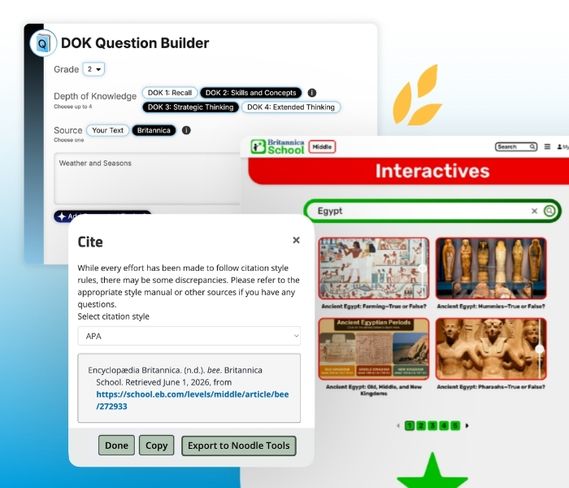
Teach Britannica, for Educators, with Love
Read More: Teach Britannica, for Educators, with Love
Summer Reading Ideas for Kids: Free Activities & Book List
Read More: Summer Reading Ideas for Kids: Free Activities & Book List
Practical Jokes or Practical Adaptations: Can You Find These Critters?
Read More: Practical Jokes or Practical Adaptations: Can You Find These Critters?
Join Our Newsletter
From tips and tricks to engaging activities, find
attention-grabbing content for tomorrow’s lesson.